Abstract:The Indian rupee settled at 95.15 against the US dollar on 5 August 2026, gaining 13 paise after the Reserve Bank of India's Monetary Policy Committee voted 6-0 to keep the repo rate unchanged at 5.25 percent for the third time in a row in FY27. The rupee had opened 46 paise higher, rallied to an intraday strongest of 94.89 ahead of the policy decision, and then drifted back as RBI Governor Sanjay Malhotra noted that the currency 'has not appreciated as intended despite the high flows from foreign shores.' A weak dollar index, a sharp pullback in Brent crude from above USD 100 in July, and net FII equity inflows of Rs 2,447 crore on Tuesday combined to support the rupee. USD-INR is expected to trade in a 94.80-95.50 band in the near term.
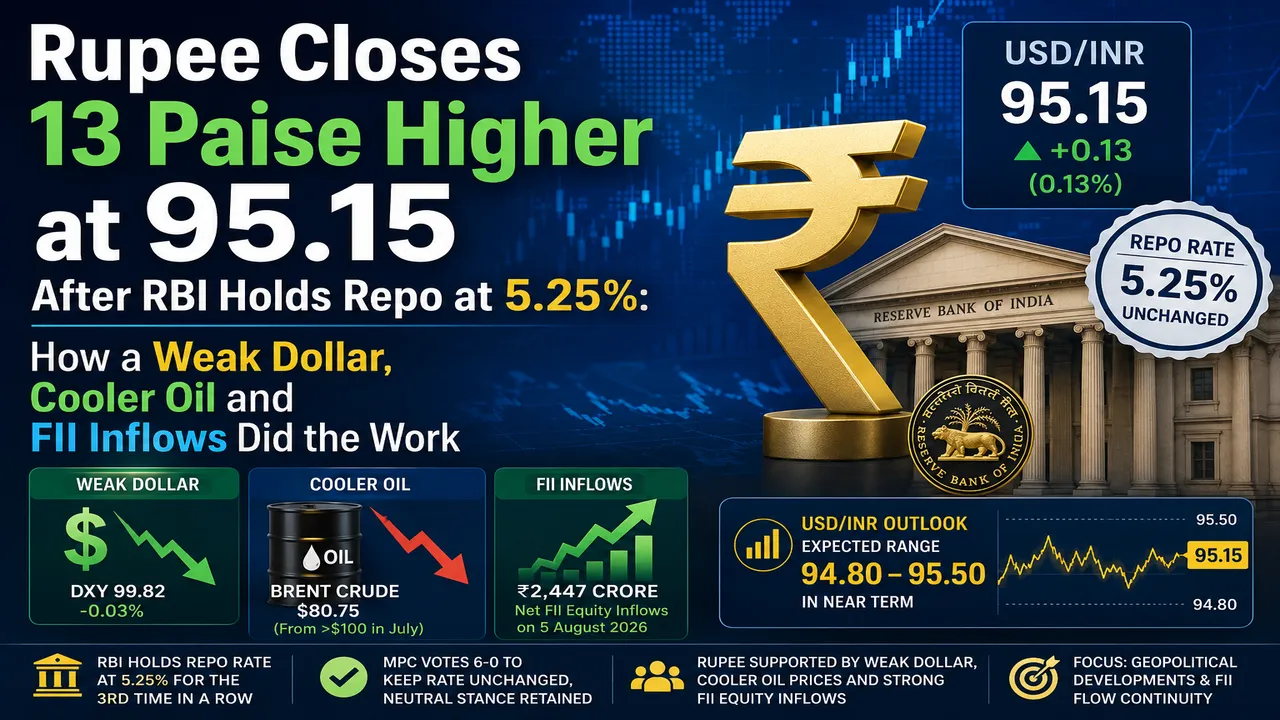
The Indian rupee settled at 95.15 against the US dollar on 5 August 2026, gaining 13 paise on the day after the Reserve Bank of India's Monetary Policy Committee kept the repo rate unchanged at 5.25 percent for the third consecutive review in FY27. The intraday story was a two-stage one: the rupee opened 46 paise higher, rallied to an intraday strongest of 94.89 ahead of the policy statement, and then drifted back into the 95-handle as Governor Sanjay Malhotra told reporters that the rupee 'has not appreciated as intended' despite heavy capital inflows.
 Contents
Key Points
Closing print: USD/INR settled at 95.15 on 5 August 2026, up 13 paise from the previous close of 95.28. The intraday range was 94.89 to 95.25, a tight 36-paise band.
RBI verdict: Repo rate held at 5.25% for the third time in a row in FY27. The six-member Monetary Policy Committee voted 6-0 to keep the rate unchanged and retained a 'neutral' policy stance.
What did the work: A weaker dollar (DXY 99.82, -0.03% intraday), Brent crude cooling to USD 80.75 from above USD 100 in July, and net FII equity inflows of Rs 2,447 crore on Tuesday combined to support the rupee.
The Intraday Journey: Open, Peak and Close
livemint.com reported that the rupee opened 46 paise higher against the US dollar ahead of the policy decision. BusinessLine later reported the rupee at 94.89, up 39 paise from the previous close, the strongest level of the sessionahead of the RBI statement. Rediff MoneyWiz reported the closing print at 95.15, with the rupee trading in a 94.89 to 95.25 range during the dayafter the RBI verdict.
Why the Rupee Moved: Three Forces, One Direction
Forex traders cited an overnight decline in crude oil prices and weakness of the American currency in the overseas market. The dollar index, which gauges the greenback against a basket of six currencies, was trading at 99.82, down 0.03 percent on the day. A decline in US treasury yields also supported the rupee, traders said.
Brent crude, the global oil benchmark, was trading at USD 80.75 per barrel in futures trade, up 1.75 percent on the day but sharply lower than the levels above USD 100 seen in July. India imports the bulk of its crude, so a cooler oil price eases the import bill and supports the rupee on the margin.
Foreign institutional investors purchased equities worth Rs 2,446.47 crore on a net basis on Tuesday, according to exchange data. Domestic equity markets were also firmer, with the Sensex up 152.05 points to 78,581 and the Nifty up 9.75 points to 24,624.65.
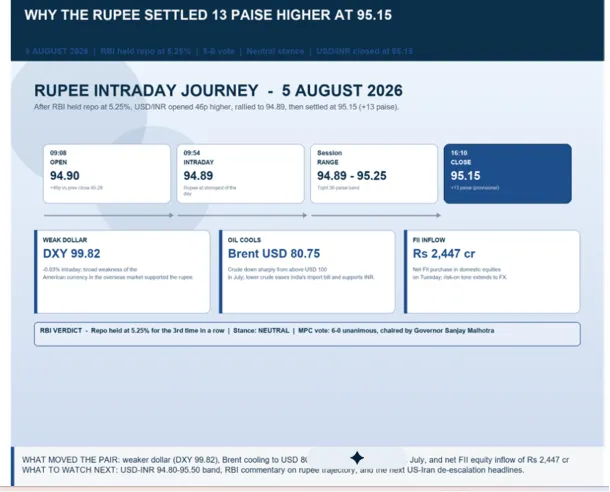
Figure 1. The closing print of 95.15 followed an open of 94.90 and an intraday strongest of 94.89 ahead of the RBI policy statement.
What the RBI Said About the Rupee
Speaking to reporters after the policy review, Governor Sanjay Malhotra said the rupee has not appreciated as intended despite the high flows from foreign shores. He further noted that strengthening in the rupee is possible if geopolitical tensions de-escalate, and that the RBI's endeavour will be to keep the trajectory for the rupee orderly.
The RBI relied on measures announced at its previous policy meeting to attract capital inflows and support the rupee. The reference was to a package of measures rolled out at the prior review that was meant to pull in foreign portfolio investment, ease hedging costs for exporters and importers, and reduce volatility in the FX market.
The unanimous 6-0 vote and the retention of the 'neutral' stance are signals in their own right. A neutral stance leaves the RBI free to move in either direction at the next review, while the unanimous vote indicates the committee saw no case for either a cut or a hike at this meeting, even as it acknowledged that geopolitical risk around the West Asia crisis remains elevated.
Market Voices: Where USD/INR Goes Next
Mirae Asset ShareKhan: Anuj Choudhary, Research Analyst at Mirae Asset ShareKhan, said the rupee is expected to trade with a slight positive bias on improved global risk sentiment amid de-escalation of tensions between the US and Iran. The US said that a deal with Iran could be reached soon. Traders may take cues from ISM services PMI data from the US. The USD-INR spot price is expected to trade in a range of 94.80 to 95.50.
Three Things to Watch in the Next Session
1. RBI Commentary on Rupee Trajectory
Governor Malhotra's observation that the rupee 'has not appreciated as intended' will be parsed carefully by markets. If the RBI signals tolerance for a stronger rupee, the unit could test the 94.80 lower bound of the expected band. If the RBI emphasises orderly depreciation, the upper bound of 95.50 becomes the reference.
2. US-Iran De-escalation Headlines
Brent crude has already pulled back from above USD 100 in July to USD 80.75. Any sign of a US-Iran deal would extend the move lower and remove a major source of upward pressure on the rupee. Conversely, a flare-up would re-tighten oil, push the dollar higher, and likely push USD-INR back above 95.50.
3. FII Flow Continuity
Net FII buying of Rs 2,447 crore on Tuesday was a support, but the rupee still drifted back from 94.89 to 95.15 by the close, suggesting that equity inflows alone are not enough to push the rupee decisively stronger. Watch for daily FII flow prints and any sign of reversal in equity sentiment, which would also weigh on the rupee.
Final View: Hold, Not Hike, and Not Cut
The third consecutive hold at 5.25%, combined with a neutral stance and a unanimous vote, tells the market that the RBI is in no rush to change course. The rupee gained 13 paise, not because the RBI pushed it, but because the dollar weakened, oil cooled, and foreign investors kept buying. Watch the 94.80-95.50 band, and watch the next round of US-Iran headlines; those two forces together are likely to set the tone for USD/INR over the next week.
Editorial Note: This article reports the closing price, the policy decision, and the supporting market forces as described by Rediff MoneyWiz, BusinessLine, and livemint.com on 5 August 2026. It does not forecast a specific USD/INR level. Investors should rely on RBI press releases, the dollar index, and crude oil prints for confirmation before making decisions.
Download the WikiFX app for the latest forex news, updates and investigations.

Knowledge pays at WikiFX.
Every time you share a WikiFX article, you'll receive 50 Reward Points. Grow your rewards with every share and unlock exclusive gifts in the WikiFX Points Mall. Start earning today!

Interesting Articles for You
Launches GOLD24-7: Weekend Gold Trading Goes Live
Review 2026: Users Report Disturbing Withdrawal Issues - Is the Broker Still Reliable?
Review 2026: Why Some Users Report Withdrawal Problems - and What the Evidence Shows
Fortex White Label in 2026: Can Your Liquidity Stack Scale Without Losing Control?
A Fortex white label can look like the fastest route to a modern branded trading environment, but a fast launch is not the same as a controlled launch. This 2026 broker guide explains what the Fortex platform is, where a Fortex broker solution can sit in a wider operating stack, and how to evaluate the difference between a white label, a server licence, and a connected CRM or Client Office setup. It also unpacks Fortex cost beyond the monthly headline, including implementation, integration, support, data, governance, migration, and exit assumptions. Use the practical questions, workflow tests, comparison table, and launch checklist to assess a Fortex provider without mistaking a feature demo for evidence that your brokerage can run the service safely at scale.
News
2026-08-03
Further Reading
White Label in 2026: Can Your Liquidity Stack Scale Without Losing Control?