

Global Broker Regulation Inquiry App
About WikiFX
English
简体中文
繁體中文
English
Pусский
日本語
ภาษาไทย
Tiếng Việt
Bahasa Indonesia
Español
हिन्दी
Filippiiniläinen
Français
Deutsch
Português
Türkçe
한국어
العربية
اردو


Hawkish Easing: Sterling Rallies

WikiFX
|


Abstract:The British pound staged a tactical recovery above 1.3250 as investors factored in a shallower path of Bank of England rate cuts, while the Swiss franc remained adrift in thin trading.
The Anomaly
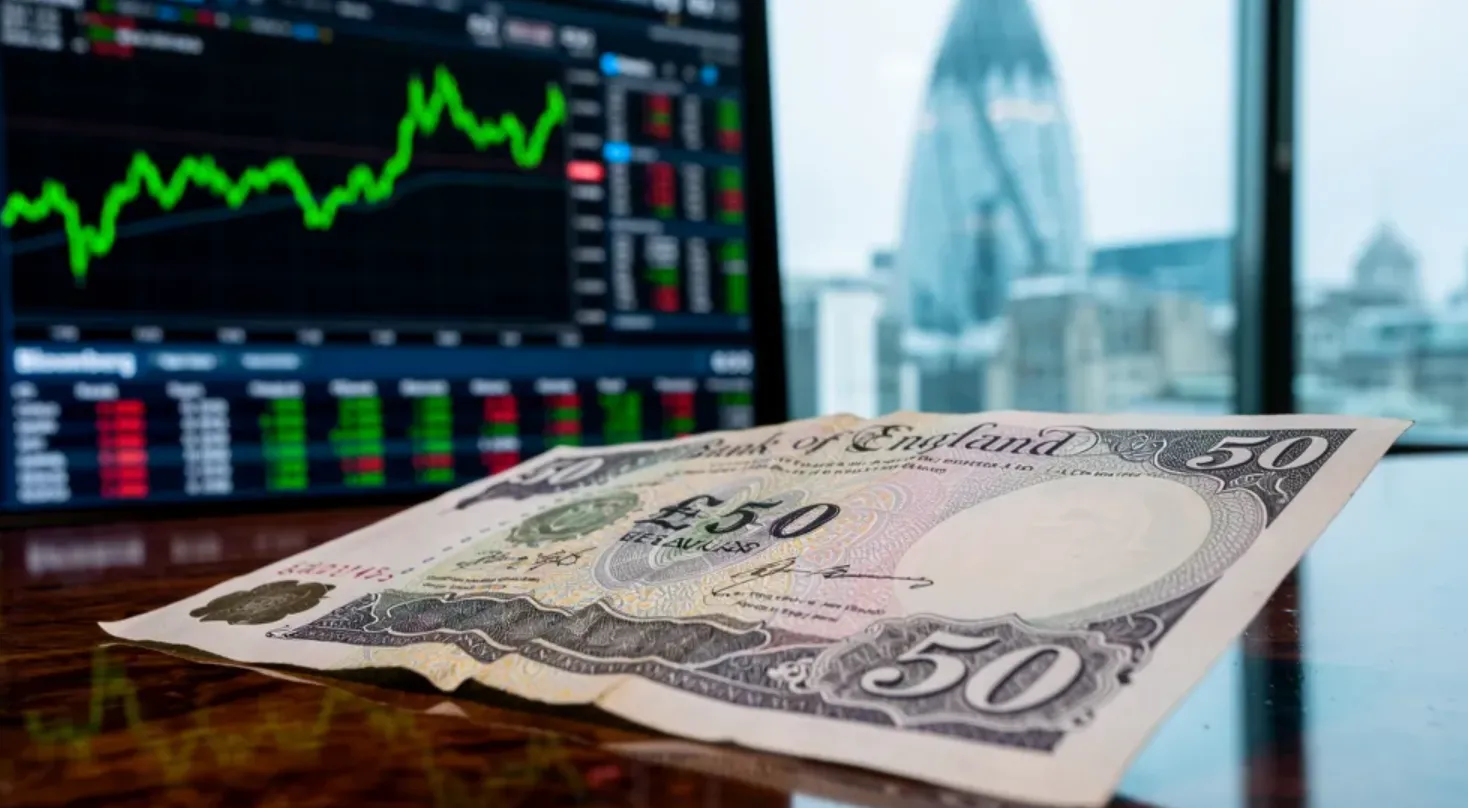
The British pound is strengthening precisely because its central bank is committed to cutting rates. GBP/USD has reclaimed and held above 1.3250 while the broader dollar index maintains its own firmness—a configuration that standard interest rate parity theory struggles to accommodate. Classical FX mechanics dictate that a currency facing an active easing cycle should depreciate as yield differentials compress. Instead, sterling is drawing institutional support from the BOE's cutting narrative, not in spite of it. The contradiction is structural: markets are not rewarding the pound for high rates, but for the relative restraint of its cutting cycle compared to peers. The currency is appreciating on a dovish signal. That is the glitch.
The Structural Mechanics
Liquidity & Flows
The critical variable is not the absolute level of BOE rates but the rate of change relative to competing central banks. Swap markets are currently pricing two BOE cuts by year-end. That figure, in isolation, reads bearish. In context, it represents a shallower easing gradient than what is being discounted for the European Central Bank and, increasingly, the Federal Reserve. Global macro funds running long-duration FX carry books are not abandoning sterling—they are rotating into it as the least-dovish major currency in the European complex. Carry flows require yield differential, and the BOE's forced caution is manufacturing exactly that. The flow logic is directionally counterintuitive but mechanically coherent.
Derivatives & Hedging
Sterling's grip above its nine-day exponential moving average is not purely organic. Options positioning in GBP/USD shows a concentration of short-gamma exposure clustered near the 1.3200–1.3250 band. Market makers who sold puts at those strikes during the recent leg lower are now systematically delta-hedging by purchasing spot GBP as price action approaches and breaches those levels from below. This gamma-driven bid is mechanically pinning the floor. It does not reflect fresh directional conviction from real-money accounts. It reflects the structural obligation of options dealers to hedge their book—a technical force that reinforces the level without necessarily validating it.
Policy Divergence
The BOE's paralysis is itself a policy stance. UK services inflation and wage growth have remained adhesively above target, stripping the Monetary Policy Committee of the flexibility their G10 peers currently exercise. The fiscal backdrop compounds this: UK government spending commitments have sustained domestic demand in a manner inconsistent with rapid disinflation. The result is a central bank that wants to ease but cannot do so aggressively without credibility risk. That institutional constraint—the gap between the BOE's intended path and its executable path—is functioning as an accidental hawkish anchor for the currency.
The Historical Contrast
The 2013 Taper Tantrum offers a partial analogue. Then, the mere signaling of a slower-than-expected Fed easing trajectory triggered sharp USD appreciation and EM capital flight. Sterling's current dynamic inverts that logic at the bilateral level: the BOE's slower-than-expected cutting path is generating a localized version of the same repricing effect, pulling capital toward GBP rather than away. The critical structural difference is the derivatives architecture. In 2013, the rates options market lacked the depth and dealer-intermediation infrastructure that today converts policy ambiguity into systematic hedging flows. Present-day gamma exposure translates central bank hesitancy directly into spot price support, a transmission mechanism that did not operate with comparable efficiency a decade ago.
The Current Paradigm
Sterling's stability above 1.3250 is not a verdict on UK economic health. It is a residual output of relative monetary restraint in an environment where every major central bank is easing simultaneously but at differentiated speeds. The pound has become, by default, the least-dovish asset in a dovish European field. Meanwhile, the Swiss franc's suspension around 0.8000 in thin holiday liquidity illustrates the opposing condition: a currency whose traditional safe-haven function has been actively suppressed by its own central bank, leaving it without a fundamental anchor in either direction. Both currencies are currently defined not by what their economies are doing, but by the policy ceilings their central banks have imposed on their own flexibility. That is the regime: FX valuation determined by the speed of retreat from yield, not by yield itself.

Disclaimer:
The views in this article only represent the author's personal views, and do not constitute investment advice on this platform. This platform does not guarantee the accuracy, completeness and timeliness of the information in the article, and will not be liable for any loss caused by the use of or reliance on the information in the article.
WikiFX Broker
Latest News
Navi Mumbai Police Book 2 in Alleged Iridium Investment Scheme Promising Rs 28 Crore Return
WikiFXPakistan's Foreign Exchange Reserves Inch Higher to $26.86 Billion After Small Weekly Gain
WikiFXWhy Modern Traders Are Choosing PrimeXBT: Broker overview and Key Benefits
WikiFXAnalysis: Everyone expects the Fed to hold rates in October. Kevin Warsh could surprise us all
WikiFXUS Dollar Price Forecast: Warsh Holds Fire, DXY Tests 101.80 as EUR/USD, GBP/USD Gain
WikiFXUK must protect against Russian \hybrid attacks\, ex-national security adviser says
WikiFXSensex Posts Best Day in 4 Months as India Dodges Global AI Rout
WikiFXRBI has burned through half of its $140 billion FX war chest defending the rupee, bankers say
WikiFXU.S. Dollar Rebounds From Session Lows As Oil Rallies: Analysis For EUR/USD, GBP/USD, USD/CAD, USD/JPY
WikiFXMTrading Broker Review: Regulated but Is It Safe for Traders?
WikiFX