


Global Broker Regulation Inquiry App
About WikiFX
English
简体中文
繁體中文
English
Pусский
日本語
ภาษาไทย
Tiếng Việt
Bahasa Indonesia
Español
हिन्दी
Filippiiniläinen
Français
Deutsch
Português
Türkçe
한국어
العربية
اردو
GFS Review 2026: Withdrawal Complaints, Weak Regulation Data, and Account Access Risks
Abstract:GFS shows a high-risk profile on the provided WikiFX data: a 1.57 score, no verified financial regulator listed, and a D influence rating. The complaint record is also serious, with repeated withdrawal, account-access, high-fee, and platform-related allegations across several countries.
Executive Summary (TL;DR): GFS is presented in the provided WikiFX data as an Australia-based broker established in 2019, but WikiFX shows no verified financial regulator for it and gives it a score of 1.57. The risk picture is not built on one complaint alone: the cases include repeated reports of failed withdrawals, blocked or deactivated accounts, high trading costs, and website or login access problems.
Before you find a broker and send money, the first question is not whether the account opening page looks simple. It is whether you can verify who supervises the firm, how client money is handled, and whether other traders can get their funds back. In this GFS review, the available data points to a cautious answer.
GFS is described as a Forex and CFD broker with MT5 access, one account type, and products covering Forex, CFDs, commodities, metals, indices, and stocks. The WikiFX Score shown in the source data is 1.57, with an influence rating of D and 20 user complaints received by WikiFX over the recent three-month period mentioned in the broker summary. That combination deserves close attention before any deposit.
 Contents
Regulation and Safety
The strongest safety concern is the GFS regulation status. The provided WikiFX safety section states that no relevant financial institution regulation was found for GFS. The regulator list is empty, and the safety level is shown as 0. Although GFS is described as headquartered in Australia and established in 2019, the source data does not provide a verified license number, regulator name, or license type.
For you as a trader, that matters. Without confirmed regulation, there is less visible protection around dispute handling, custody of client funds, business conduct, and operational transparency. A regulated broker is not automatically risk-free, but regulation can give clients a formal channel for complaints and may require safeguards such as segregation of client funds. With GFS, the provided data does not confirm those protections.
One exposure case from the United Kingdom praised GFS and mentioned ASIC regulation. However, that is a user statement inside a case, not verified license data in the WikiFX broker profile. The broker profile itself lists no regulator. For risk assessment, the verified profile data should carry more weight than an isolated positive comment.
WikiFX Score and Visible Risk Signals
The WikiFX Score for GFS is 1.57. Treat that as a live data point rather than a permanent verdict, but it is clearly low in the available record. The summary also says the broker has 20 complaints received by WikiFX within the referenced recent three-month period and warns users to pay attention to risk.
The listed disadvantages are also direct: GFS is not regulated by any regulator in the provided data, has multiple exposure records, and has many customer complaints. Its advantages are listed as longer operating time, online customer service support, and EA support. Those advantages do not offset the core safety issue by themselves, especially where withdrawal complaints are numerous.
Trading Conditions
GFS offers one account type. The listed products include Forex, CFDs, commodities, metals, indices, and stocks. The maximum leverage is high: Forex up to 1:500, indices up to 1:500, commodities up to 1:100, and metals up to 1:200. High leverage can make a small account look powerful, but it also means adverse price moves can drain equity quickly.
The account information shows a main spread “from 0,” a minimum cash figure of 0.01, stop-out ratio of 50.00, and support for scalping, locked positions, and EA trading. Cryptocurrency trading is not allowed. The brokers product list is broad enough for active Forex trading, but the complaint record raises questions about the real cost experience.
Several traders alleged very high fees, wide spreads, poor exchange rates, or heavy slippage. One China-based complainant said the GBP/USD spread reached around seven points and that commission was USD 50 per lot. Another said total spread and commission costs caused losses of more than USD 60,000 and alleged that agents pushed heavy trading through competitions and training groups. These are complaint allegations, not audited fee schedules, but they appear repeatedly enough that you should verify all trading costs in writing before trading.
Platform and Account Access
GFS uses MT5, and the software information describes MT5 as customizable, multilingual, and offering clear fee reports. The WikiFX software qualification is listed as MT4/5 with a “Perfect” rating type. EA trading is supported.
There is still an account-security detail worth noting. The software description says the reviewed MT5 setup lacks two-step login and biometric authentication for safer login access. That does not prove a login failure by itself, but it means you should be careful with account credentials, official website links, and any request to enter details outside the verified site.
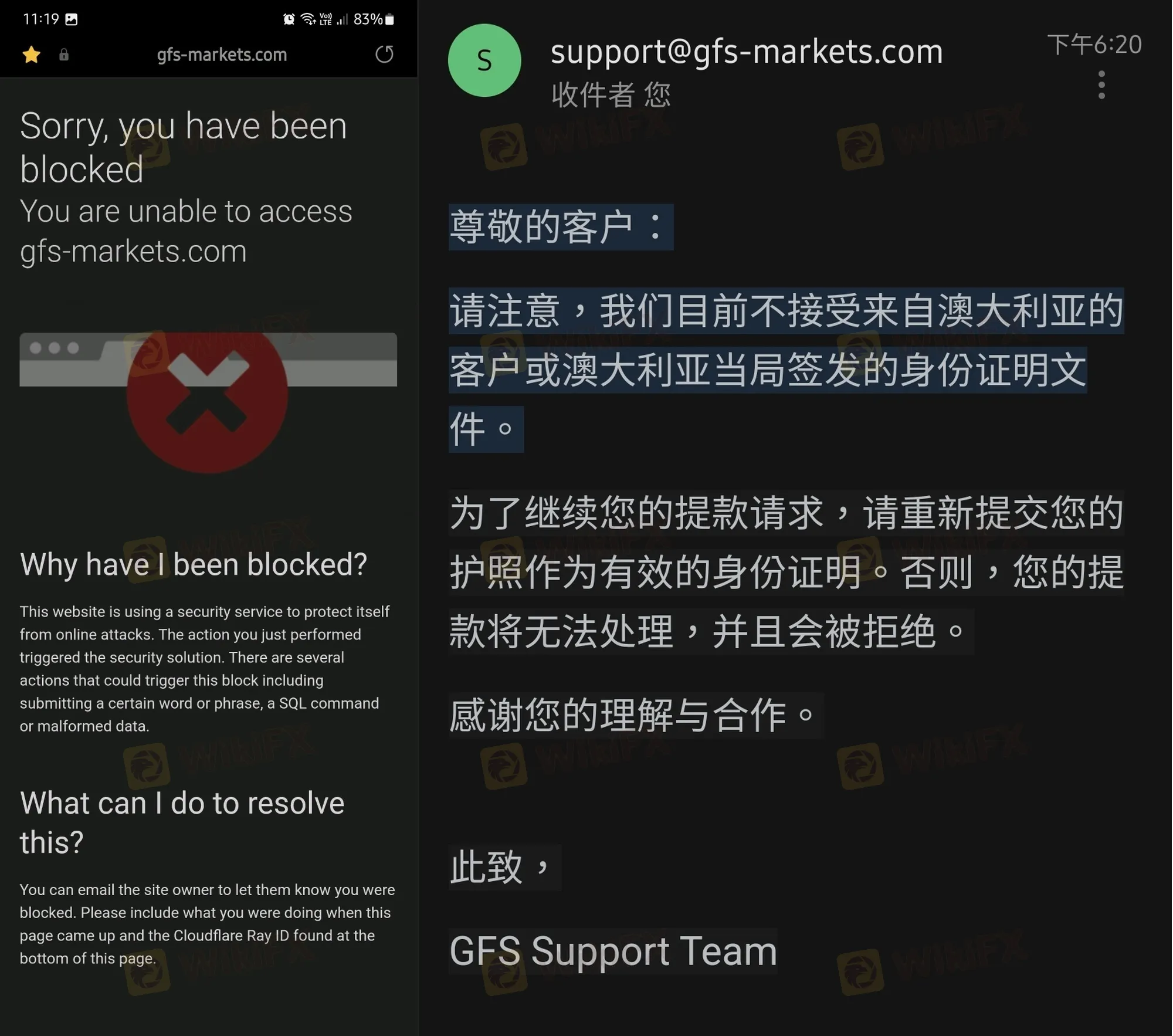
The website list includes several legal website URLs in the data, including gfs-markets.com and related domains. Some complaints, however, describe sudden inability to access the company site or log in. An Australian complainant said the Australian website link was suddenly closed, they could not enter the website or log in, and customer service replied that Australian KYC documents were not being accepted. The user said funds remained in the trading account. Screenshots were attached to support the account-access and withdrawal context.
Trader Complaints and Exposure Cases
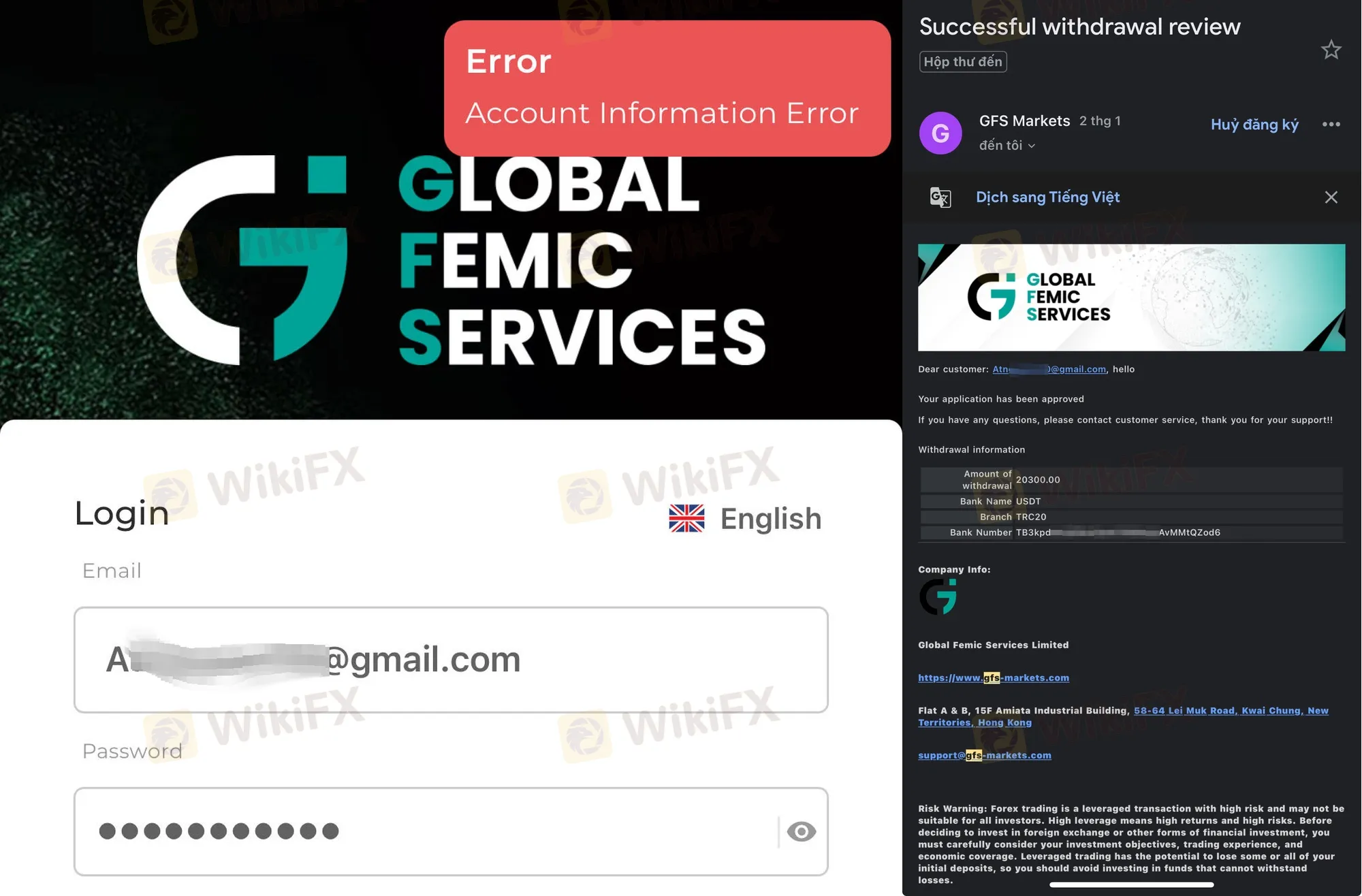
The complaint pattern is the most troubling part of this review. Multiple Vietnam-based users reported being unable to withdraw money. One said support marked a USDT withdrawal as successful, but the funds never arrived in the wallet; after being told processing would happen after the Lunar New Year holiday, the withdrawal still had not been completed, emails went unanswered, and the user could no longer log in to the company website. The user attached withdrawal-related screenshots.
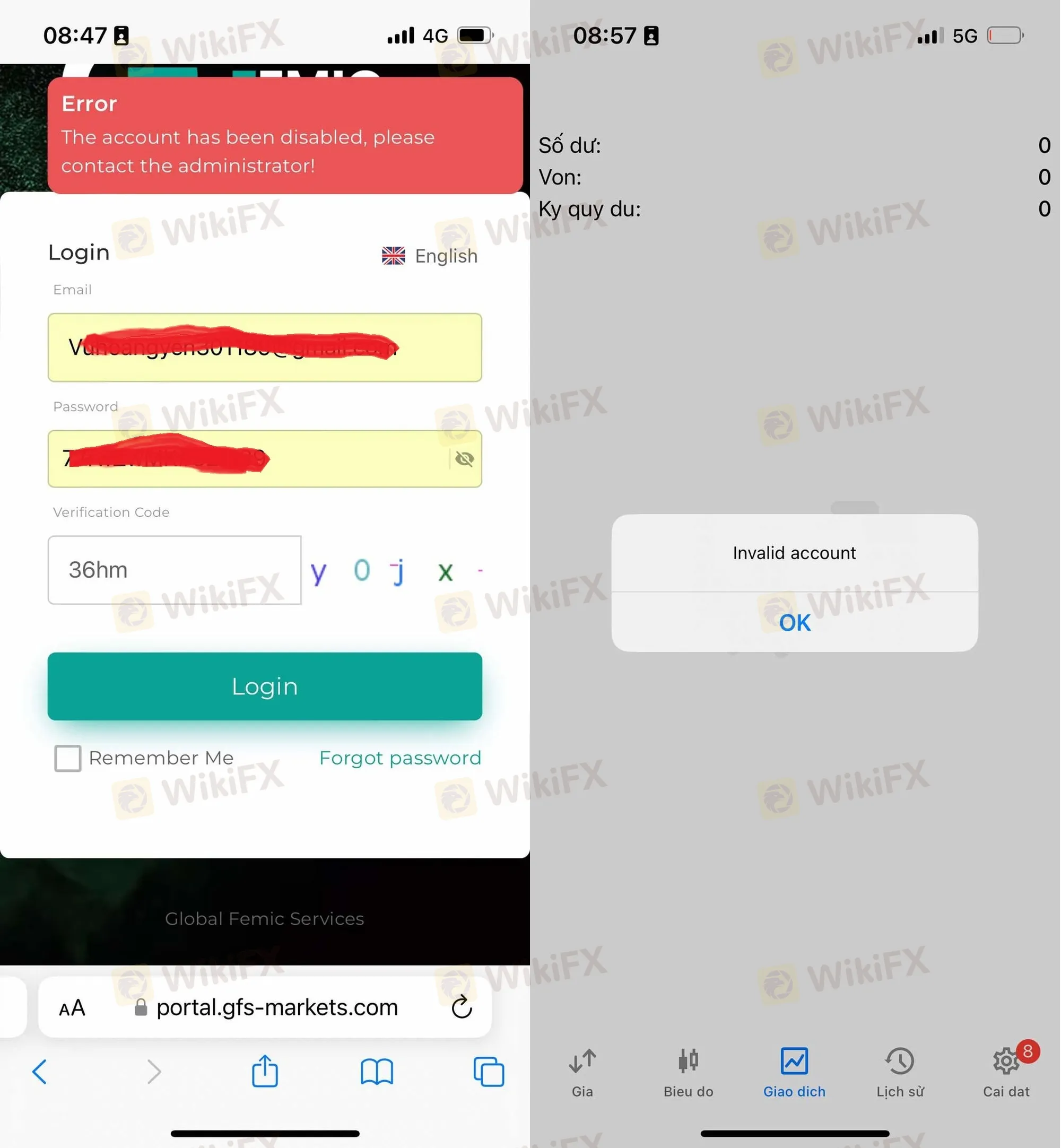
Other Vietnam cases reported bank withdrawals failing, withdrawals pending for seven days despite a 24-hour confirmation expectation, profit withdrawals delayed for more than a week, and accounts allegedly closed or blocked while funds could not be withdrawn. One case said all closing orders from February 28 and 29 disappeared, the account balance was lost, and withdrawal was impossible.
A Norway-based user alleged that after trying to reconnect to MetaTrader 5 and contacting support, the account was locked and deactivated without notice.
A Korea-based case reported that server testing showed no connected server for GFS while other licensed exchanges tested normally. These claims point to platform-access risk, although they remain user-submitted exposure reports.
There are also complaints about intermediary promotion. Several China-based users alleged that agents used stock-related groups, competitions, and training rooms to push people into Forex trading on GFS, encouraging frequent or heavy trades while collecting high commissions and spreads. If a broker introduction comes through a chat group promising returns, competitions, or copied signals, treat it as a red flag and slow down.
Deposits, Withdrawals, and Support
Customer service is listed as English-only by email at support@gfs-markets.com. The source summary says users can receive most relevant answers, but waiting times may be long. That is a limited support setup for a broker handling international clients.
Withdrawal complaints are frequent and varied: delayed USDT transfers, disabled USDT withdrawals, forced conversion into other currencies, alleged exchange-rate losses, unanswered emails, and account access failure. One Malaysia-based user said a USDT TRC20 deposit was later subject to withdrawal complications, including a claimed 1% fee, disabled USDT withdrawal, and a 7.6% exchange-rate difference from the market rate. Evidence images were provided.
Final Verdict: Should I open an account?
Based only on the provided WikiFX data and exposure cases, GFS looks high risk. The broker has a low WikiFX Score of 1.57, no verified regulator shown in the profile, a D influence rating, high leverage up to 1:500 for Forex, and repeated complaints involving withdrawals, website access, account deactivation, high costs, and support delays.
If you are still considering GFS, do not rely on promotional claims or social-media introductions. First verify the latest regulation data, test customer support, read all fee and withdrawal terms, and avoid depositing money you cannot afford to lose. Status changes daily. Before depositing, check the WikiFX App for the latest real-time certificate.

Disclaimer:
The views in this article only represent the author's personal views, and do not constitute investment advice on this platform. This platform does not guarantee the accuracy, completeness and timeliness of the information in the article, and will not be liable for any loss caused by the use of or reliance on the information in the article.
WikiFX Broker
Latest News
OROKU EDGE Review 2026: Blacklist Warnings, Withdrawal Complaints, and High Leverage
 WikiFX
Reading the Market Weather: How to Identify Forex Trends and Ranges
WikiFXUsing Volatility and ATR to Fix Your Forex Stop Loss
WikiFXIs It Your Fault for Falling for an Investment Scam?
WikiFXPIPS STAR Review 2026: Unregulated Status and What Indian Traders Should Check
WikiFXHousewife Loses RM250,000 Life Savings to Ghost Investment Scheme Promising 10% Returns
WikiFXDeltaFX Review 2026: My MT5 Account Was Locked During Trade. Did the Trader Lose Everything?
WikiFXCan AI Really Improve Forex Trading? The Benefits, Risks and Hidden Limitations
WikiFXStoneX Review 2026: Should You Trade with This Broker?
WikiFXYen Firms While Dollar Pauses
WikiFXCurrency Calculator
USD

CNY
Current Rate:0
Enter amount
USD
Redeemable Amount
CNY
Calculate 