


Global Broker Regulation Inquiry App
About WikiFX
English
简体中文
繁體中文
English
Pусский
日本語
ภาษาไทย
Tiếng Việt
Bahasa Indonesia
Español
हिन्दी
Filippiiniläinen
Français
Deutsch
Português
Türkçe
한국어
العربية
اردو
Why Heavy Lot Sizes and Secret Robots Drain Trading Accounts
Abstract:Many new traders quickly drain their capital not because they lack intelligence, but because they struggle with heavy position sizing, volatile news events, and misleading automated systems. This article breaks down why these common traps destroy accounts and how pacing your trades can keep you in the market.
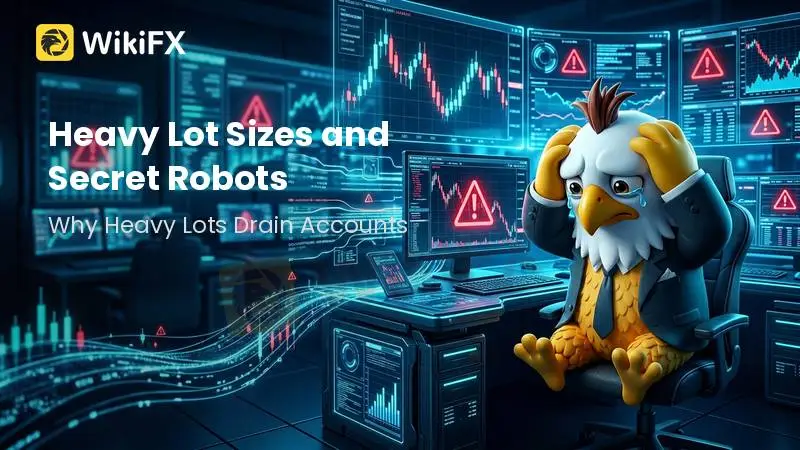
A lot of new traders enter the market expecting smooth sailing, only to find their account drained within a few weeks. The culprit usually is not a lack of intelligence. It is a mix of panic, heavy position sizing, and placing too much trust in automated systems or random signals.
When you do not have a fixed set of rules, your profits rely entirely on luck. To survive the learning curve, you need to understand why simple trades suddenly become stressful and how you can actually keep your account alive.
 Contents
The Trap of Heavy Lot Sizes
Your trade size dictates your emotional state. If you have a $5,000 account, taking a 0.1 lot size (a standard unit of measurement for currency trades) means you can comfortably let a trend play out. Earning 100 pips (the smallest price move a currency makes) while risking 50 pips feels manageable because you have given the trade room to breathe.
But if you open a massive 10-lot trade on that same account, every tiny price fluctuation plays with your emotions. Because the financial swing is so large, you might grab a quick 20-pip profit just out of relief. Worse, a sudden 50-pip drop will wipe out a massive chunk of your capital before you can react.
Heavy lot sizes distort your psychology. When a trade goes slightly against you, fear kicks in, and you might close it too early. Trading light buys you time to be wrong, endure random market noise, and correct your mistakes without blowing up your account.
Surviving Major Data Drops
Beginners often love the thrill of major economic data releases, like the US Non-Farm Payrolls (NFP). They try to guess the market direction right as the employment numbers drop, hoping to catch a massive wave.
The reality is that major data does not instantly establish a clean trend. In the first few minutes, prices often whip violently in both directions. This happens because large market players are clearing out stop-loss orders (automatic exit points set by traders to limit losses).
The most practical approach is to simply step back. Wait 30 to 60 minutes after a major data release. Let the initial chaos settle. If the market refuses to push further in the direction of the news, or if a clear, steady trend finally emerges after the dust settles, that is your actual opportunity to enter safely.
The Illusion of Secret Robots and Copy Trading
Everyone wants a shortcut. As you learn to trade, you will constantly see ads for Expert Advisors (EAs), which are automated trading robots. You will also see promotions for copy trading, where your account automatically mirrors someone else's trades.
An EA is just a software program following mathematical rules. Its main advantage is that it removes fear and greed from the equation. However, a robot cannot adjust its own risk profile when global economic conditions suddenly shift. It just keeps executing its code. There is no “secret indicator” hidden inside these robots—indicators are just basic algebra applied to past prices.
Be highly skeptical of extravagant weekend seminars that charge huge training fees, only to funnel you into a specific broker. Another common trap is the “funded account” job setup, where a company provides you with trading capital but demands expensive upfront training fees, and then asks you to top up the account with your own money when you take losses.
If a salesperson pressures you to wire money immediately to secure a limited-edition trading software, walk away. The Forex market trades trillions of dollars daily; one piece of retail software is not going to corner the market.
No software or mentor can bypass the need for proper risk management. Keep your lot sizes small, avoid jumping into the middle of news spikes, and rely on your own verified testing rather than aggressive sales pitches. If you are ever unsure about a broker recommended by a seminar or an EA provider, you can look them up on WikiFX to verify if they actually hold a legitimate regulatory license before you deposit a single ringgit.


Disclaimer:
The views in this article only represent the author's personal views, and do not constitute investment advice on this platform. This platform does not guarantee the accuracy, completeness and timeliness of the information in the article, and will not be liable for any loss caused by the use of or reliance on the information in the article.
WikiFX Broker
Latest News
ECB hikes interest rates for first time since 2023 as Iran war ramps up energy costs
 WikiFX
RaiseFX Review 2026: Is This Forex Broker Safe?
WikiFXIBKR VIP limited Review: No Regulation, Withdrawal Blocks, and a Broker Warning
WikiFXFXVIEW Review 2026: Regulation, Platform Access, and Complaint Signals
WikiFXWhy Holding a Winning Forex Trade Feels Harder Than Holding a Loss
WikiFXHow a Cambodia Scam Trapped Korean Investors with Fake Trading App & False Profits
WikiFXCNMV Warns Against 10 Unauthorized Investment Platforms and Clone Firms
WikiFXDollar Steadies As US Inflation Reaches 4.20%
WikiFXFrom Demo to Real Money: Overcoming the Fear of Holding Your First Live Trade
WikiFXWhy Market News and Spread Shocks Sweep Your Stop Loss
WikiFXCurrency Calculator
USD

CNY
Current Rate:0
Enter amount
USD
Redeemable Amount
CNY
Calculate 