Abstract:WikiFX Elite Club Focus is a monthly publication specially created by the WikiFX Elite Club for its members. It highlights the key figures, perspectives, and actions that are truly driving the forex industry toward greater transparency, professionalism, and sustainable development.
WikiFX Elite Club Focus is a monthly publication specially created by the WikiFX Elite Club for its members. It highlights the key figures, perspectives, and actions that are truly driving the forex industry toward greater transparency, professionalism, and sustainable development.
In each issue, we center on a core industry topic and engage in in-depth conversations with Elite Club members—documenting authentic thinking and presenting practical experiences that can be verified.
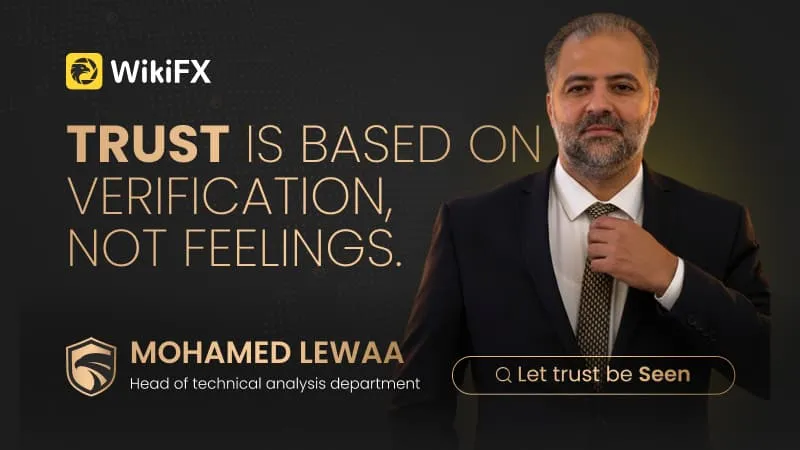
For our inaugural issue, themed “Making Trust Visible,” we interviewed Mr. Mohamed Lewaa, an Elite Committee member of the WikiFX Elite Club and Head of the Technical Analysis Department at Halan Securities.
Q1: Could you briefly introduce your background, career experience, and role in the industry?
Mohamed Lewaa:
I am currently the Head of the Technical Analysis Department at Halan Securities and hold both the CFTe and CETA certifications. I have over 14 years of experience in banking and financial markets.
Beyond my institutional role, I also run my own financial services brand, Maven for Financial Markets Services, and regularly publish technical analysis reports for Investing.com and TradingView.
For me—whether within an institution, through my personal brand, or via content creation—the core objective has always been the same: to help traders build a more controlled and rational decision-making framework in uncertain markets.
Q2: As a seasoned IB/KOL, how do you believe professionals should convey the right trading mindset and risk awareness to retail investors?
Mohamed Lewaa:
I consistently adhere to several fundamental principles:
First, firmly reject the “get rich quick” narrative.
Trading is neither gambling nor a shortcut to overnight success. It is a long-term, systematic process of wealth management. The goal should be sustainable financial health, not short-term excitement.
Second, help investors establish clear objectives.
Investments should serve concrete life goals—such as retirement planning, home ownership, or capital preservation. Clear objectives and time horizons are essential to maintaining rationality during market volatility.
Third, use discipline to counter emotion.
What truly determines success is not forecasting ability, but execution. Predefined strategies, systematic investing, and periodic rebalancing are far more important than chasing rallies or panic selling.
Fourth, maintain transparency and realism.
I never exaggerate returns or downplay risks. One message must be repeated constantly: past performance never guarantees future results.
Q3: In your view, how does “trust” specifically manifest in the forex industry?
Mohamed Lewaa:
Trust is not an abstract concept—it is observable and verifiable. It primarily exists on three levels:
First, regulatory compliance and fund security.
Being regulated by authoritative bodies such as the FCA or ASIC is the most basic threshold of trust.
Second, operational transparency.
This includes clear execution models (STP/ECN), verifiable pricing mechanisms, and explicit disclosure of spreads, commissions, and swap fees.
Third, rule clarity and comprehensibility.
Whether terms are clearly stated or contain hidden restrictions determines whether traders may suffer “unexpected harm” at critical moments.
Q4: What is the most difficult aspect of building or maintaining trust?
Mohamed Lewaa:
The hardest part is long-term consistency.
In the forex industry, a single bad actor can damage the reputation of the entire sector, while rebuilding trust requires years of persistence from countless rule-abiding participants.
Q5: Have you encountered situations where trust was undermined due to a lack of transparency?
Mohamed Lewaa:
Very often.
- Some unregulated platforms delay or block withdrawals through vague terms.
- Some “dealing-desk” platforms profit by manipulating quotes or triggering stop losses.
In early 2026, investigations also uncovered serial fraud cases involving forged documents and fake transfer records to misappropriate investor funds. These actions are, at their core, direct violations of trust.
Q6: Why do many traders fail to see truly critical information?
Mohamed Lewaa:
The reasons are not complicated—rather, they stem from the combination of three factors:
- Psychological bias: people prefer to believe “good news”
- Information overload: key risks are buried under noise
- Complex market structures: significant asymmetry between regulation and business models
As a result, traders often ignore information precisely where attention is most needed.
Q7: Do you follow a consistent set of risk-protection principles?
Mohamed Lewaa:
I adhere to three iron rules:
- Risk per trade should not exceed 1–2%
- Every trade must have a stop-loss
- Risk–reward ratio should be no less than 1:2
These are not techniques—they are survival rules. Without them, even a high win rate is meaningless.
Q8: In your ideal vision, what would a more trustworthy forex market look like?
Mohamed Lewaa:
It would be a market where trust is built on verification, not feelings.
Success would come from discipline and competence—not luck in avoiding traps.
Q9: What role do you believe WikiFX and the WikiFX Elite Club play in the development of the forex market?
Mohamed Lewaa:
The role of WikiFX —
Driving transparency and standardization
By establishing a centralized information platform, WikiFX effectively addresses long-standing information asymmetry in the forex industry. Traders can check the regulatory status, licenses, and operational history of over 70,000 brokers on a single platform, forming a unified and comparable evaluation framework to identify unregulated or high-risk entities.
Investor protection mechanisms
WikiFX also serves as a market “safety net.” The platform provides public complaint and exposure channels and conducts on-site inspections to verify brokers actual office operations. Combined with continuous risk monitoring and alerts, these mechanisms help investors identify risks, recover losses, and reduce exposure to fraud or misconduct.
Education and tool support
Beyond disclosure, WikiFX offers systematic educational content and practical tools, including industry articles, tutorials, market analysis, and trading calculators—helping traders build rational decision-making capabilities rather than relying on intuition or market sentiment.
The role of the WikiFX Elite Club —
Promoting a safer industry ecosystem
The Elite Club brings together professionals from different regions to break information silos, advocate responsible practices, and build consensus around trading safety and industry ethics.
Thought leadership and professional insight
Through forums, in-depth interviews, and cross-regional exchanges, members continuously share real-world experience and professional judgment—helping quality, compliant institutions gain visibility while gradually filtering out bad actors.
Facilitating multi-party collaboration
The Elite Club also serves as a collaborative network linking experts, regulatory stakeholders, media, and traders, fostering self-regulatory mechanisms and supporting the long-term, healthy development of the forex market.
Q10: How do WikiFXs products and services contribute to transparency and standardization in the industry?
Mohamed Lewaa:
Centralized data and verification systems
WikiFX maintains a regulatory database covering over 60 global regulatory authorities, enabling users to verify broker legitimacy, license status, and compliance history in real time—significantly improving due diligence efficiency and consistency.
Relationship mapping and risk identification
Through relationship-mapping technology, WikiFX reveals hidden connections among brokers, such as cloned platforms or concealed white-label relationships—helping users see beyond surface compliance and reduce misjudgment risks.
On-site inspections and community accountability
Via the “WikiFX Field Survey” program, teams conduct on-site visits to brokers worldwide to verify office locations, team size, and actual operations. Findings are presented publicly with visual evidence, exposing fake offices or shell platforms.
In addition, WikiFX provides public complaint and exposure channels for issues such as fraud or withdrawal difficulties. As of 2026, WikiFX has assisted thousands of investors through its coordination mechanisms, helping resolve disputes and recover losses amounting to millions in funds.
About the WikiFX Elite Club
The WikiFX Elite Club is one of the most influential high-end communities in the global forex industry. It brings together professionals with strong expertise and industry influence who are committed to integrity and compliance. The Club works to break regional and informational barriers, promote safer and more transparent trading environments, and advocate responsible industry development.
Through thought exchange, market insight, and cross-border collaboration, the WikiFX Elite Club embraces its industry responsibility—helping build a secure, transparent, and sustainable global trading environment, and fostering a healthier, more open, and dynamic forex ecosystem.