Abstract:It is a challenge for most market participants to wrap their heads around negative values for assets. In Europe and Japan, short-term interest rates in negative territory have become the norm. Banks charge depositors for storing their cash balances.

In commodity markets, we have seen markets move to levels where those holding long positions wind up paying other market participants to close positions. This can occur in the futures as well as the physical markets. The payment is not just market differences between the purchase and sale price. There have been instances where a purchase at zero turned into a losing proposition.
In the 1950s, the US regulators closed the onion futures market on the Chicago Mercantile Exchange as the price of the root vegetable fell into negative territory. At the time, trading in onions accounted for around 20% of the volume on the exchange. Market manipulation caused the price volatility in onions that have not traded in the futures market since 1958.
A raw material market can fall below zero
Negative commodity prices are nothing new, as other raw materials have declined to levels where sellers pay buyers to take a commodity off their hands. While some markets have seen zero or negative prices, others never experienced the phenomenon.
Aside from onions, another futures market has traded at or below a zero price. The power or electricity market is a use-it or lose-it market. The electric power runs along transmission lines, and if not consumed by a party that holds a long position, it becomes worthless or can even trade at a negative price.
April 20, 2020, was a day to remember in the crude oil market
Before April 20, 2020, the all-time modern-day low for the price of NYMEX crude oil was $9.75 per barrel, the 1986 bottom. In late April 2020, the price fell through that low and reached zero.
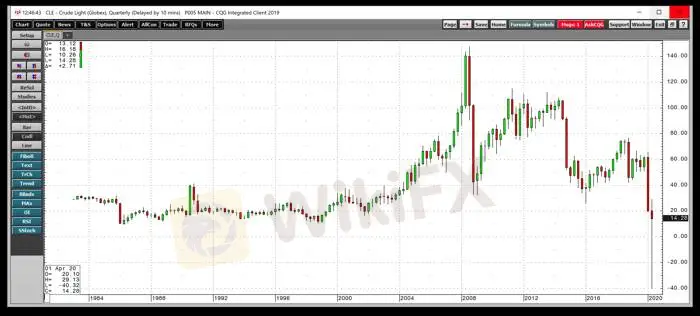
The quarterly chart highlights the decline to a low that few traders, investors, and analysts thought possible.
Some market participants likely purchased nearby futures at or near zero, assuming that they were buying at a price that was the sale of the century. They turned out to be tragically wrong. Crude oil fell to a low of negative $40.32 per barrel on April 20. The problem in the oil market was that there was nowhere to put the oil as storage facilities were overflowing with the energy commodity.
Historically, oil traders with access to capital purchased nearby futures and sold deferred contracts at times when contango, or the future premium, was at high levels. The theory behind owning the nearby contract and selling the deferred contract is that those who can store and finance the energy commodity gain a risk-free profit.
Holders of the spread hedge the price risk with the sale of the deferred contract and own the physical in case the market tightens, which is a call option on the spread. Meanwhile, speculators often synthesize the cash and carry trade using nearby and deferred futures without the ability to store the energy commodity. When nearby futures dropped to over negative $40 per barrel, the unexpected losses for those holding synthetic positions were staggering.
Storage capacity is the critical factor
Supply capacity is the crucial factor for any market participant holding a long position in a nearby futures contract. Without the ability to take delivery and store the commodity, there is a potential for negative price levels. Assuming that the downside is limited to zero is wrong. Another market that could face a similar fate in the future is natural gas, where storage capacity is finite, and the price could venture into negative territory at some point.
Without the ability to store and finance a commodity, the downside risk is theoretically as unlimited as the upside.
Negative commodity prices may seem irrational, and it is always tempting to buy something for zero. In the world of commodities futures and some of the physical markets, zero could turn out to be a high price as the oil market taught us on April 20, 2020.