Abstract:The United States and China have published reciprocal tariff-cut lists covering about $30 billion of goods on each side, $60 billion in total. Neither list is in force. China's covers 1,619 categories of American products. America's covers 77 categories of Chinese goods. Soybeans are on neither.
That omission is the first thing to register. Soybeans are the largest single US agricultural export to China, and they stay subject to China's 10% additional tariff even as corn, wheat, sorghum, beef and dairy come off the list.
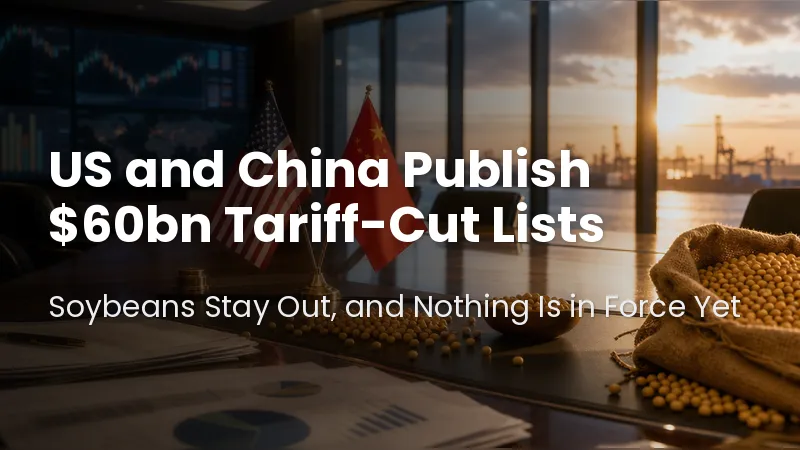
The United States and China have published reciprocal tariff-cut lists covering about $30 billion of goods on each side, $60 billion in total. Neither list is in force. China's covers 1,619 categories of American products. America's covers 77 categories of Chinese goods. Soybeans are on neither.
That omission is the first thing to register. Soybeans are the largest single US agricultural export to China, and they stay subject to China's 10% additional tariff even as corn, wheat, sorghum, beef and dairy come off the list.
 Contents
What is Actually on the Two Lists
China's list removes its 10% retaliatory duty on US corn, wheat, sorghum, rice, barley, beef, dairy, vegetable oils and meals, fish, seafood, logs and wood products. The original post also puts coal and medical devices inside the 1,619 categories. China's commerce ministry issued the list on Monday, India Today reported.
The US list is far narrower. It covers toys, fireworks, Christmas ornaments, car seats and small appliances, plus tableware and holiday decorations.
Coal gets its own line. China pledged at least 10 million tonnes of US coal in 2027 and another 10 million tonnes in 2028 — 20 million tonnes across two years. That commitment sits outside the tariff lists and runs on its own clock.
Scale check. The $60 billion basket covers roughly 30% of US goods exports to China. Bilateral goods trade last year was about $415 billion. So the thaw is real money, and it is a sliver of the relationship.
What is deliberately absent matters as much as what is present. Chips, EVs and batteries are off the table on both sides. Whole soybeans are excluded. The deal is a consumer-goods and farm-goods arrangement, not a technology settlement.
Where the Lists Came from
Both were published on September 28, after last week's Trump-Xi summit. US Trade Representative Jamieson Greer and Treasury Secretary Scott Bessent confirmed the reciprocal cuts alongside Chinese Vice Premier He Lifeng, according to Global Agriculture.
The two sides also extended their broader trade truce, first struck in Busan, South Korea, through January 10, 2027. That extension is the only part of this package with a date attached. The tariff lists do not have one.
That runway cuts both ways. It gives both governments more time to negotiate something fuller. It also means the underlying tariff structure on soybeans can persist through the next North American planting season, which is already shaping how US growers think about acreage for next year.
Why Soybeans Were Left Out
China has leaned heavily on Brazil this year, drawing on a large 2025/26 South American harvest, and kept buying some US cargoes under commercial arrangements agreed earlier in the year. That reduced the urgency, from Beijing's side, of formally cutting the rate in this round.
The American Soybean Association had pushed Washington to secure soybean relief specifically, given China's status as the crop's largest export market. Traders described the omission as a disappointment when the lists came out. Futures reaction was mixed rather than dramatic.
Neither government has explained the exclusion in detail. A new bilateral agriculture working group is due to convene before the end of the year, and soybeans are expected back on its table.
Published is not the Same as Done
The original post is blunt about this: “This is not tariffs already cut today. This is a recommended list. Implementation still needs domestic legal processes. No start date yet.”
Business Standard uses the same word — recommended — for the $30 billion each side has put forward for more favorable tariff treatment. So the operative document right now is a proposal, not a rate change. Until a start date appears, the lists are paperwork.
For an Indian trader, the transmission is indirect. There is no INR leg in this deal. What moves is the input: global risk sentiment, dollar volatility, and the price of coal and agri commodities, which get a small push in both directions.
Where the Accounts Do Not Line Up
Three gaps worth flagging before you trade the headline.
The post lists medical devices among China's 1,619 categories. The wire and trade-press coverage available here describes farm goods, seafood, wood and energy. Medical devices appear only in the post.
The post says 1,619 categories. Several reports say “thousands of products” without giving a number.
And the framing differs. The post says the cuts are recommended and not yet in force. Some coverage reads as though the cuts are agreed. Both can be true — agreed at the political level, pending domestic legal process — but the distinction is the difference between a headline and a rate.
Social media: One Bullish Post, Five Bearish Ones
Six posts on this beat, and they do not tell one story.
The tariff post itself is the bullish one. In its framing, a cooling US-China tariff war removes one source of imported inflation and dollar volatility, and gives FIIs one less headline to check before they touch Nifty.
The rest of the feed is bearish on India. ETMarkets flagged a Rs 6 lakh crore wipeout, with the Sensex down 900 points and the Nifty below 22,900. NDTV Profit called it the longest weekly slide since 2020, with crude above $107 and US bond yields spiking. Kunal Saraogi's post argues the Nifty has fallen 22% in USD over two years with no risk premium for emerging markets.
On rates, Moneycontrol and Stock Incubator both point to a Reuters poll expecting the RBI to raise to 5.50% in October as inflation broadens. That is a social-media citation of a poll, not a confirmed policy move.
One more headline sits in the same feed: a post from the same account saying Iran denied any deal to halt uranium enrichment, after Saudi channel Al-Hadath reported Tehran had agreed to suspend it. Unverified, and it points the other way for crude.
The common thread across all six is that India's own macro pressure — crude, yields, rate expectations — is doing more work on positioning than any US-China list.
What This Does to Your Positions, and What to Watch
The rupee has no direct exposure to this list. The dollar does. A tariff thaw that holds reduces one source of dollar volatility, which is mildly supportive for the rupee and mildly negative for USD/INR carry trades that rely on stress.
Crude is the bigger input right now. If Brent stays above $107 as the NDTV Profit post describes, India's import bill and the rupee's terms of trade dominate anything inside a $60 billion US-China basket.
On rates: if the RBI does move to 5.50% in October, forward points on USD/INR tend to widen, which raises the cost of carrying a short USD/INR position. If it holds, that cost stays where it is. Either way, the trigger is the policy meeting, not the tariff lists.
Dates for the calendar. The agriculture working group meets before the end of the year. The Busan truce extension runs to January 10, 2027. The post points to the next Trump-Xi meeting in November. And there is still no start date for the tariff cuts themselves — that is the number to wait for before treating this as a rate change rather than a recommendation.
Download the WikiFX app for more in-depth financial news and insights.

Knowledge pays at WikiFX.Every time you share a WikiFX article, you'll receive 50 Reward Points. Grow your rewards with every share and unlock exclusive gifts in the WikiFX Points Mall. Start earning today!