Abstract:The Reserve Bank of India's special FCNR (B) deposit scheme pulled in about $127 billion from non-resident Indians — well over its initial $50 billion target. Banks are now scrambling to replace short-term borrowings with longer-term overseas funding, while critics say the true cost of the scheme could be enormous.
The scheme, announced on 5 June and closed on 31 August, was designed to shore up forex reserves. But a thread by @sandeep_PT, with 67 likes, argues the RBI bears the risk of rupee depreciation on these deposits, making the hidden cost "very large." Banks offered unusually high interest rates, which will eventually fall on borrowers and shareholders. And the dollar inflows add huge rupee liquidity, forcing the RBI to absorb excess money — potentially raising government borrowing costs.
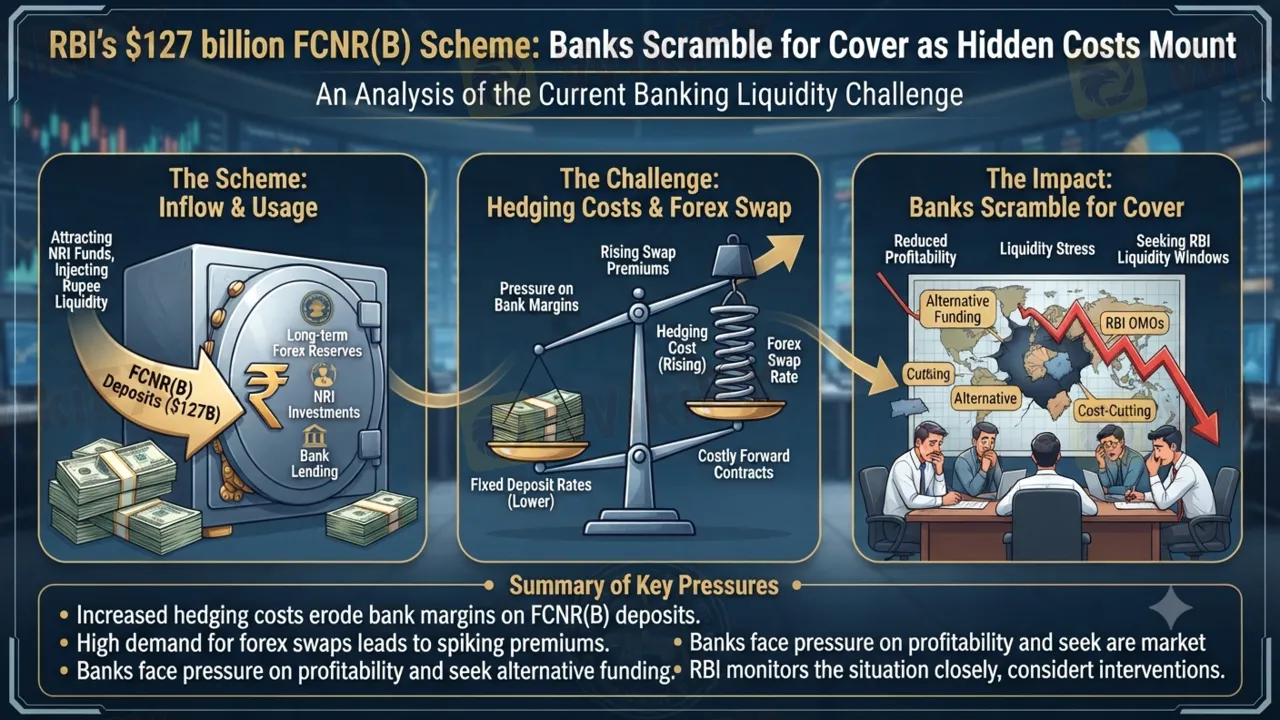
The Reserve Bank of India's special FCNR (B) deposit scheme pulled in about $127 billion from non-resident Indians — well over its initial $50 billion target. Banks are now scrambling to replace short-term borrowings with longer-term overseas funding, while critics say the true cost of the scheme could be enormous.
The scheme, announced on 5 June and closed on 31 August, was designed to shore up forex reserves. But a thread by @sandeep_PT, with 67 likes, argues the RBI bears the risk of rupee depreciation on these deposits, making the hidden cost “very large.” Banks offered unusually high interest rates, which will eventually fall on borrowers and shareholders. And the dollar inflows add huge rupee liquidity, forcing the RBI to absorb excess money — potentially raising government borrowing costs.
 Contents
The Numbers Behind the Deluge
According to The Hindu, the RBI mobilized around $127 billion through major Indian commercial banks, dramatically overshooting the target. The strong response prompted banks to raise funds faster than expected, leading the central bank to close the window a month early.
Bank of America Securities, in a research note, said FCNR (B) deposits have become a significantly cheaper funding source for banks than conventional rupee deposits. Banks offered interest rates between 5.25% and 6% on foreign currency deposits, versus 6.5%–7.5% for rupee deposits, and the RBI bears the hedging cost. FCNR (B) deposits are also exempt from CRR and SLR requirements, freeing up more funds for lending.
But the brokerage argued the RBI could earn around 4.5%–5% on the foreign reserves generated, potentially offsetting hedging costs of up to 3%. BofA also noted that after the previous FCNR (B) scheme matured in 2016, a quarter of the deposits stayed in the system.
Banks' Refinancing Push
A TradingView report, citing five treasury officials, says several lenders turned to short-term borrowing to bridge the gap while arranging longer-term funding. They now want to replace those short-term liabilities with longer-term overseas borrowings to reduce reliance on money-market funding.
Punjab National Bank, Bank of Baroda, Axis Bank, RBL Bank, Federal Bank, Canara Bank, UCO Bank, Bank of Maharashtra and IndusInd Bank are in early talks for overseas fundraising through the RBI's OFCB facility. State-run REC Ltd is also considering a yen-denominated bond. The OFCB route offers a 1.5% annual subsidy on hedging costs, which typically run 3.5%–4%, giving banks a benefit of 200–250 basis points.
“The OFCB route is a cheaper option relative to domestic borrowing. The fact that, like the FCNR scheme, currency risk is taken on by the RBI adds to the attractiveness,” one official said.
Who Pays for the Hidden Cost?
Critics focus on the implicit burden. The RBI absorbs the exchange-rate risk; if the rupee weakens against the dollar, the central bank books a loss. Banks' high deposit rates also push up funding costs, which get passed on to borrowers and eat into shareholders' returns.
There's a liquidity headache too. Telangana Today reports the RBI absorbed over Rs 3.53 lakh crore through an overnight VRRR auction to drain cash surplus. Economists warn that higher-than-expected FCNR flows will complicate liquidity management, forcing the RBI to deploy more tools. That could push up short-term rates and raise the government's cost of borrowing.
Divergent Views from the Street
Not sees the scheme as a burden. BofA argues the RBI's earnings on foreign reserves could offset hedging costs. The Hindu quotes the brokerage: “By most term sheets, larger banks have offered rates between 5.25%-6% on foreign currency deposits and with FX risk everyone borne by the RBI, FCNR (B) become a much cheaper source of funding.”
But Livemint columnist Ajit Ranade takes a different line: “RBI owes the public an explanation for its exorbitant dollar deposit scheme.” The abrupt closure, he writes, masks the true cost.
@sandeep_PT puts it bluntly: “Greater transparency and accountability is needed now, and RBI should publicly explain the scheme's full costs, benefits and fiscal risks. That is not happening (for now).”
The RBI has not commented on the critique. Finance Minister Nirmala Sitharaman, however, reviewed the swap schemes on Monday and urged banks to step up NRI outreach — suggesting the government remains supportive.
What You Should Watch
The numbers are clear, but the final bill isn't. If the rupee weakens, the RBI's hedging costs climb. If liquidity gets too tight, banks may pass on costs to borrowers. Deposit rates could nudge up as banks refinance.
Keep an eye on the RBI's liquidity operations — the next VRRR auctions will show how much surplus cash the system holds. Also watch for any public statement from the RBI on the scheme's cost. That would be the first real signal.
Your own FCNR (B) or NRE deposits? The reversal risk is real. In 2016, after the previous scheme matured, deposits fell by three-quarters. Some money stayed, but most left. Plan accordingly.
Download the WikiFX app for more such in-depth financial insights.

Knowledge pays at WikiFX.Every time you share a WikiFX article, you'll receive 50 Reward Points. Grow your rewards with every share and unlock exclusive gifts in the WikiFX Points Mall. Start earning today!