

Global Broker Regulation Inquiry App
About WikiFX
English
简体中文
繁體中文
English
Pусский
日本語
ภาษาไทย
Tiếng Việt
Bahasa Indonesia
Español
हिन्दी
Filippiiniläinen
Français
Deutsch
Português
Türkçe
한국어
العربية
اردو


UK Inflation Today: 3 GBP Scenarios Traders Should Prepare For

WikiFX
|


Abstract:The Office for National Statistics scheduled the UK July 2026 inflation release for 19 August. Before the bulletin is published, the latest confirmed baseline is June CPI at 2.6% year on year and CPIH at 2.8%. The cleanest way to cover today's data is to compare the official result with expectations and then check services inflation, core inflation and the monthly change before drawing conclusions for GBP.
| Quick answerThe Office for National Statistics scheduled the UK July 2026 inflation release for 19 August. Before the bulletin is published, the latest confirmed baseline is June CPI at 2.6% year on year and CPIH at 2.8%. The cleanest way to cover today's data is to compare the official result with expectations and then check services inflation, core inflation and the monthly change before drawing conclusions for GBP. |
 Contents
Quick Answer
What is Confirmed—and What is Not
ONS confirmed a 7:00am UK-time release for July consumer price inflation. The June bulletin showed CPI slowing to 2.6% from 2.8%, while CPIH eased to 2.8% from 3.0%. Those numbers are context, not a forecast for July.
Do not publish an estimated July figure as though it were official. Once the release page goes live, replace the opening paragraph with the verified CPI, CPIH, core and services readings, add a visible update time, and link to the bulletin rather than a screenshot or a third-party calendar.
- Known: July CPI is scheduled for release on 19 August 2026.
- Known baseline: June CPI was 2.6% year on year; June CPIH was 2.8%.
- Not yet confirmed in this draft: the July outcome and the market's immediate reaction.
Four Details That Can Matter More Than Headline CPI
First, compare the result with consensus rather than simply with the previous month. Second, check services inflation because it can influence how investors assess domestic price persistence. Third, review core inflation and the monthly rate to see whether the annual move was broad or driven by base effects. Fourth, read the ONS contribution analysis to identify whether transport, food, housing-related costs or another category drove the change.
A headline that falls for a one-off reason can produce a different policy interpretation from a broad cooling across services and core measures. The article should explain the composition before declaring the data 'good' or 'bad'.
- Headline CPI and CPIH.
- Core CPI and services inflation.
- Monthly change and the largest category contributions.
- The surprise relative to market expectations.
Three Scenarios for GBP and Gilt Yields
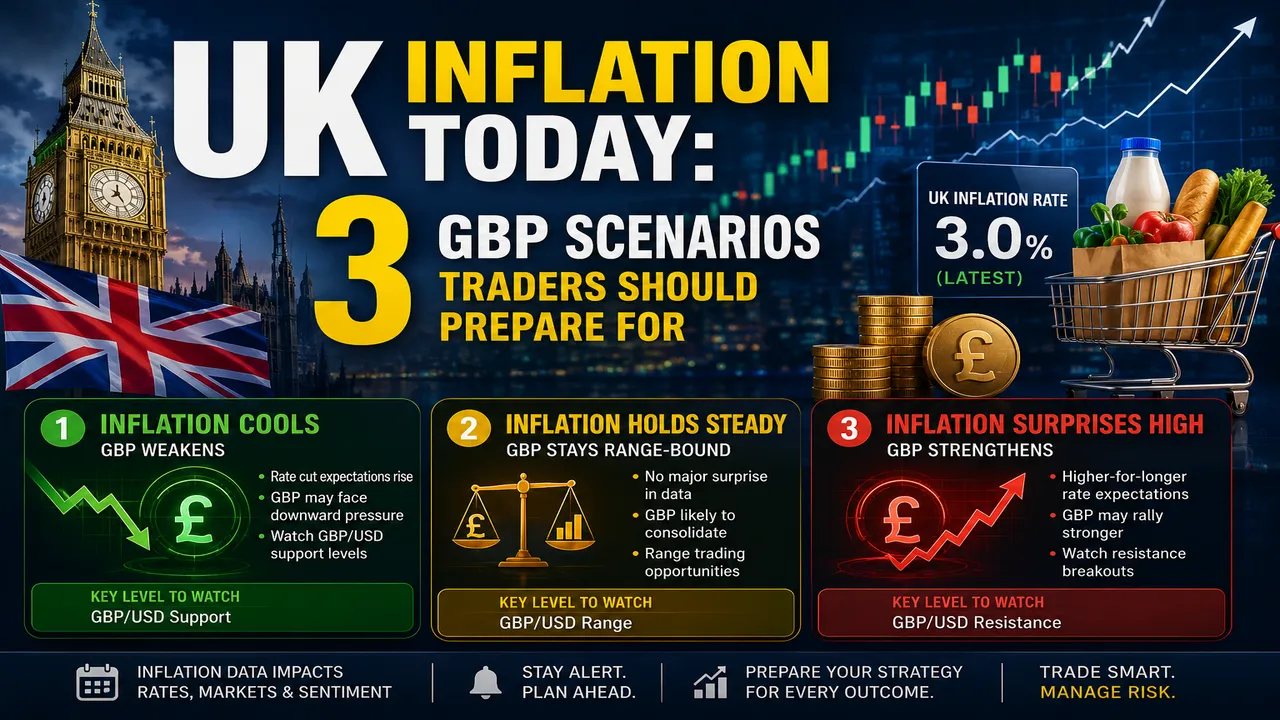
Hotter-than-expected: sticky services or core inflation could push rate expectations higher, supporting GBP and lifting short-dated gilt yields. The move may fade if the surprise comes from a narrow or volatile category.
Broadly in line: a result close to expectations may create only a brief reaction. Traders may then focus on the details, positioning and the next Bank of England communication rather than the headline.
Cooler-than-expected: broad disinflation could pull yields lower and weigh on sterling if markets price an easier policy path. Risk sentiment and the dollar backdrop can still offset or amplify the move. These are scenarios, not guaranteed directions.
A 15-minute Post-release Workflow
Minute one: save the official ONS headline figures and publication time. Minutes two to five: compare headline, core, services and monthly rates with expectations. Minutes five to ten: read the contribution section and check GBP plus two-year gilt yields. Minutes ten to fifteen: update the headline and lead with the verified surprise and explain why the composition matters.
Avoid writing 'GBP surged because inflation rose' without a timestamp and comparison. Markets react to surprises, prior positioning and simultaneous news; a price move is an observation, not proof of a single cause.
- Use the ONS bulletin as the primary source.
- State whether figures are annual or monthly.
- Add an update timestamp and label market prices with their observation time.
Action checklist
- Confirm the ONS release page is live before inserting July figures.
- Report CPI, CPIH, core, services and monthly data with the correct units.
- Compare the result with expectations and the previous release separately.
- Timestamp GBP and gilt-yield observations.
- Use conditional scenarios and avoid deterministic trade calls.
FAQs
What was the latest confirmed UK inflation rate before today's release?
ONS reported June 2026 CPI at 2.6% year on year and CPIH at 2.8%. July figures must be taken from the new bulletin once published.
Does higher inflation always strengthen GBP?
No. The response depends on the surprise, rate expectations, data composition, positioning and the broader dollar environment.
Why watch services inflation?
Services inflation is often used to assess domestically generated price pressure, although it is only one part of the policy outlook.
Sources
ONS — Consumer price inflation, UK: July 2026 release page
ONS — Consumer price inflation, UK: June 2026 bulletin
ONS — Inflation and price indices
| Risk noticeThis article is for education and event-risk planning only. It is not investment advice or a forecast. Inflation data, currencies and bond yields can move rapidly; verify the live ONS release and use risk controls appropriate to your circumstances. |
Download the WikiFX app for the latest financial updates.

Knowledge pays at WikiFX.Every time you share a WikiFX article, you'll receive 50 Reward Points. Grow your rewards with every share and unlock exclusive gifts in the WikiFX Points Mall. Start earning today!

Interesting Articles for You
Review: A 1.27 Score, Unverified Licences, and a Japan FSA Warning



Disclaimer:
The views in this article only represent the author's personal views, and do not constitute investment advice on this platform. This platform does not guarantee the accuracy, completeness and timeliness of the information in the article, and will not be liable for any loss caused by the use of or reliance on the information in the article.
WikiFX Broker
Latest News
Inflation fears on the rise as one-year outlook in Fed survey hits highest level since May 2023
WikiFXGold Near Nine Week Low as Fed Rate Fears Intensify
WikiFXTag Markets Broker Review: Regulated but Is It Safe for Traders?
WikiFXOil, Yields and French Debt Keep Global Markets Under Pressure
WikiFXLuxury Brand Owner Shot Dead After Losing US$100 Million in Trading Last Month
WikiFXKuantan Investment Scam Raids Expose RM215,000 Operation
WikiFXFBS Regulation Checks Before Choosing the Company Behind an Account
WikiFXShareflo Finds 33,675 UK Companies Behind on Filings as Director ID Checks Take Effect
WikiFXSri Lanka's NDB Bank Fraud Losses Rise to Rs. 13.6 Billion as Final Audit Flags Governance Failures
WikiFXOil Turned on Its Vertex Day: What It Means for Gold
WikiFX