Abstract:The Fed releases the July FOMC minutes on 19 August 2026. Here are three USD and gold scenarios, confirmation signals, and a practical risk checklist for traders.
Quick Answer
The 19 August FOMC minutes can move the US dollar and gold even though they describe the 28–29 July meeting. Markets will look for evidence of disagreement, the balance between inflation and growth risks, and clues about the path into the 15–16 September meeting. Prepare for three outcomes instead of betting on one headline.
 Contents
The Short Answer
Why These Minutes can Still Move Markets
The Federal Reserves official calendar lists the minutes of the 28–29 July meeting for release on 19 August 2026. Minutes are backward-looking, but they reveal the range of views inside the Committee. A sentence showing broader concern about inflation, employment or financial conditions can change the probability investors assign to the next decision.
Timing adds another layer. The next scheduled FOMC meeting is 15–16 September, while the Kansas City Feds Jackson Hole symposium runs 27–29 August. That places the minutes inside a concentrated policy-information window, when positioning may adjust quickly.
- Watch how many participants saw inflation risks as persistent.
- Look for disagreement about the appropriate policy path—not just the final vote.
- Check whether markets interpret financial conditions as tighter or looser after the release.
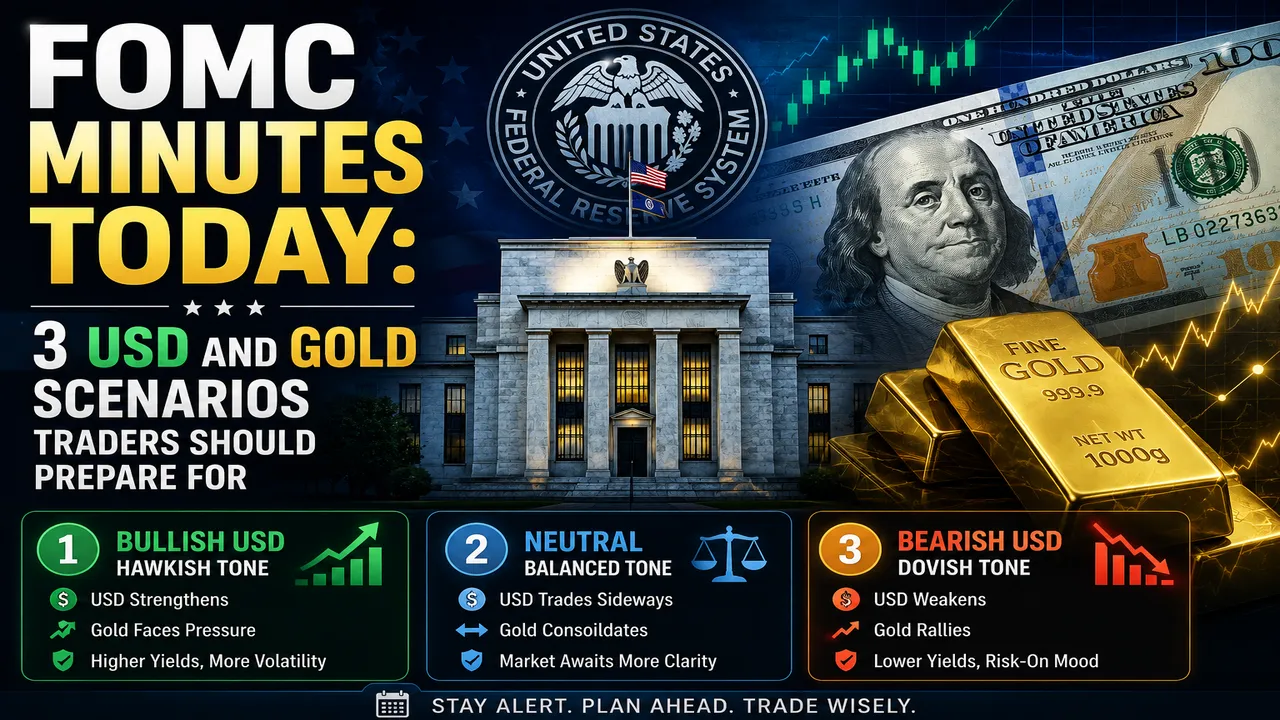
Scenario 1: The Minutes Read More Hawkish Than Expected
If the record shows broad concern about inflation or reluctance to ease, US Treasury yields and the dollar may rise. Gold could face an initial headwind because a stronger dollar and higher real yields tend to raise the opportunity cost of holding a non-yielding asset.
Confirmation matters. A durable move would usually need yields and the dollar to rise together. If the dollar spikes but yields fade, the first reaction may be driven by thin liquidity rather than a lasting reassessment.
Scenario 2: The Minutes Lean Dovish
If several participants emphasized slowing growth, labour-market risk or scope for easier policy, yields and the dollar may fall. Gold could benefit, while EUR/USD may recover. Yet a dovish reading is not automatically bullish for every risk asset: if the tone reflects a sharp deterioration in growth, safe-haven demand can distort the usual relationships.
Compare the minutes with incoming data. A softer policy interpretation is more credible when inflation and activity releases point in the same direction.
Scenario 3: Mixed Minutes and a Whipsaw
A balanced record may trigger a fast two-way move as algorithms react to individual phrases before investors read the full document. Gold, EUR/USD and USD/JPY can all reverse sharply within minutes. This is the scenario in which chasing the first candle is most dangerous.
Use a confirmation window, smaller size and predefined invalidation. If the release does not change rate expectations, the market may quickly return to positioning for Jackson Hole or the next major data print.
What to Monitor After the Headline
Read the source document and watch cross-asset confirmation. The strongest signal is not a single price move but a consistent response across rate expectations, Treasury yields, the dollar and gold.
- Two-year US Treasury yield: the clearest short-horizon policy barometer.
- Dollar index: confirms whether the reaction is broad or isolated to one currency pair.
- Gold: check whether price follows real yields or safe-haven demand.
- EUR/USD and USD/JPY: useful for separating dollar strength from local-currency drivers.
- Fed funds futures: show whether the release changed the expected September path.
Action Checklist
- Confirm the official release time on the Federal Reserve website.
- Map the prior days high, low and key liquidity zones before the event.
- Write a hawkish, dovish and mixed-response plan with invalidation levels.
- Reduce leverage and check the brokers spread and slippage policy.
- Wait for cross-asset confirmation instead of trading a single sentence.
- After release, update the article with the verified takeaway and market response.
FAQs
When are the July FOMC minutes released?
The Federal Reserve calendar lists 19 August 2026 for the minutes of the 28–29 July meeting. Confirm the exact time on the official site before trading.
Are FOMC minutes the same as a rate decision?
No. They are a detailed record of an earlier meeting, but they can change expectations about the next decision.
Do hawkish minutes always push gold lower?
No. Yields, the dollar, growth fears and positioning can interact. Use cross-asset confirmation.
What is the biggest execution risk?
A rapid two-way move, wider spreads and slippage before the full document is digested.
Sources
Federal Reserve — Monetary policy and FOMC calendar
Federal Reserve — FOMC meeting information
Kansas City Fed — Jackson Hole Economic Policy Symposium
Risk noticeThis article is for education and general information only. It is not investment advice, a trade signal or a promise of returns. FX, gold and leveraged products can produce rapid losses. Verify the official release, live market data and your brokers execution terms before making any decision.
Download the WikiFX App for the latest forex updates.

Knowledge pays at WikiFX.Every time you share a WikiFX article, you'll receive 50 Reward Points. Grow your rewards with every share and unlock exclusive gifts in the WikiFX Points Mall. Start earning today!

Interesting Articles for You

Prime of Prime Forex in 2026: The Credit and Control Questions Brokers Must Answer Before Connecting
A Prime of Prime forex arrangement can help a broker access trading relationships, credit intermediation, technology connectivity, and liquidity aggregation that may otherwise be difficult to obtain directly. But the label does not prove direct bank access, executable depth, or a particular execution outcome. This 2026 guide explains what a forex Prime of Prime, PoP liquidity provider, prime brokerage forex service, and forex prime broker proposal can mean in practice; where the credit and order-routing chain must be documented; how to test pricing, limits, rejects, records, and resilience; and which commercial terms create hidden operating cost. Use the comparison framework, red-flag list, and 90-day launch plan to assess fit for your client mix and risk model. The objective is a controllable execution dependency with traceable evidence, not a marketing claim about institutional access.
News
2026-08-17
Further Reading
Review 2026: Users Report Disturbing Withdrawal Issues - Is the Broker Still Reliable?
Review 2026: Why Some Users Report Withdrawal Problems - and What the Evidence Shows