


Global Broker Regulation Inquiry App
About WikiFX
English
简体中文
繁體中文
English
Pусский
日本語
ภาษาไทย
Tiếng Việt
Bahasa Indonesia
Español
हिन्दी
Filippiiniläinen
Français
Deutsch
Português
Türkçe
한국어
العربية
اردو
Capital Minimums, Currency Pairs, and the Reality of Exchange Risks
Abstract:A breakdown of the practical realities of starting Forex, covering the true capital minimums, how currency pairs are priced, and the importance of avoiding underground remittance traps.
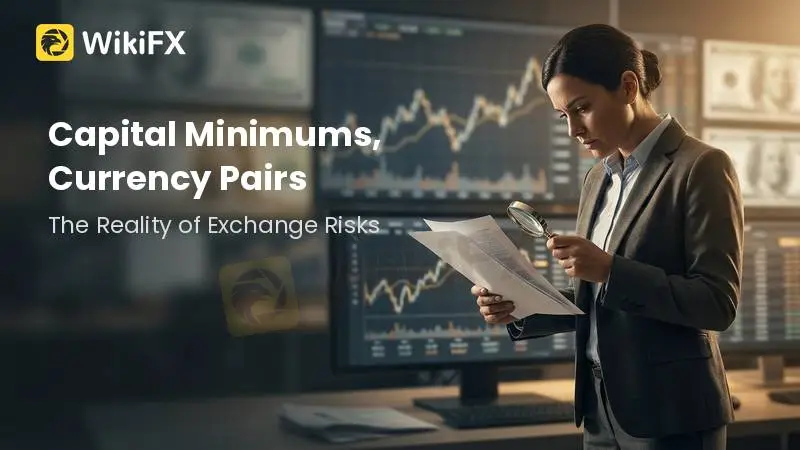
New investors often worry about how much money they need to trade and how the mechanics of buying and selling actually work. In reality, the barrier to entry in the foreign exchange market is lower than many expect. The true challenge lies in understanding how currencies are priced, managing your exchange risks, and steering clear of illegal funding channels.
 Contents
How Much Capital Do You Actually Need?
A common assumption is that you need thousands of dollars to open a trading account. In the retail Forex market, there is no universal minimum threshold.
The amount you need depends entirely on the broker you choose and the funding method you use. Some platforms allow you to start trading with just a few dozen dollars, while others may require significantly more. For example, some major retail brokers vary their minimums by deposit method—requiring $100 if you fund via wire transfer, but only $50 if you use a credit card.
Before committing your money, check the broker's specific account thresholds. This prevents the frustrating situation of opening an account only to find you do not have enough funds to actually execute a trade.
Making Sense of Currency Pairs
Trading Forex means you are simultaneously buying one currency and selling another. Because of this, currencies are always quoted in pairs, such as EUR/USD (Euro versus the US Dollar).
The first currency listed is called the base currency, and the second is the quote currency. The exchange rate simply tells you how much of the quote currency is needed to buy one unit of the base currency. If EUR/USD is trading at 1.2500, it means 1 Euro costs 1.25 US Dollars.
When navigating your trading platform, you will notice two prices for every pair: the Bid and the Ask.
- The Bid is the price your broker is willing to pay to buy the base currency from you.
- The Ask is the price at which the broker will sell the base currency to you.
Major pairs—those paired with the US Dollar, like EUR/USD or USD/JPY—see the highest trading volume globally. Because they are highly liquid, their spreads (the difference between the Bid and Ask prices) are usually very tight. Minor or exotic pairs, which involve less frequently traded currencies, have wider spreads and cost slightly more to trade.
The Realities of Exchange Rate Risk
Once you have funded an account and understand currency pairs, you face exchange rate risk. This is the danger that a currency's value will move against your position, causing a financial loss.
There are two primary types of risk that affect market participants:
- Transaction Risk: This occurs when the exchange rate fluctuates between the moment a trade or contract is initiated and when it is finally settled.
- Operating Risk: This happens when unexpected shifts in exchange rates affect the overall cost of an investment or reduce your available cash flow.
Large corporations frequently mitigate these risks by signing formal short-term or long-term contracts with banks, locking in a specific exchange rate for the future. As a retail beginner, you do not have access to corporate forward contracts. Your defense against operating risk is keeping your trade sizes small, managing your leverage, and closing positions before major economic shifts catch you off guard.
Staying Clear of Underground Channels
As you figure out how to fund your account, you will likely encounter third-party proxies offering to handle your transactions.
It is critical to avoid underground money remitters or illegal funding channels. Authorities continuously crack down on illegal foreign exchange trading and unauthorized capital transfers. Investors who use shadow channels or underground money shops to secure better rates or move large sums of money often face massive fines and the complete confiscation of their funds. If a channel operates outside the regulated banking and broker system, your money is entirely unprotected.
Your primary focus should be learning the mechanics of the market safely. Before you deposit your initial $50 or $100, use an app like WikiFX to check the background and regulatory licenses of your chosen broker. Confirming that a broker is legally regulated ensures your minimum deposit actually reaches the real market, rather than disappearing into an unauthorized underground operation.
Disclaimer:
The views in this article only represent the author's personal views, and do not constitute investment advice on this platform. This platform does not guarantee the accuracy, completeness and timeliness of the information in the article, and will not be liable for any loss caused by the use of or reliance on the information in the article.
WikiFX Broker
Latest News
Final Hours for OneCoin Victims: Billions Lost as DOJ Compensation Deadline Looms
 WikiFX
He Promised 15% Returns. Now Over 300 Investors Lost $60 Million.
WikiFXUS-Iran Tension Rattles Indian Stock Markets Today; Still Some Gained in a Gloomy Scenario
WikiFXWhy Your Buy Limit Triggered Three Days Too Late
WikiFXThe Hidden Drivers of Forex: How Bank Rates and Revaluations Move the Market
WikiFXHow to Measure True Currency Strength Beyond a Single Pair
WikiFXThe Stop Loss Safe Zone: Surviving Breakouts at Key Highs and Lows
WikiFXFXPIG Review 2026: Revoked Regulation and Withdrawal Complaints
WikiFXReview 2026: Webull FSA Regulation, Mobile App Access, and Complaint Signals
WikiFXFIBOGROUP Review: Offshore Regulation, Withdrawal Complaints, and Broker Red Flags
WikiFXCurrency Calculator
USD

CNY
Current Rate:0
Enter amount
USD
Redeemable Amount
CNY
Calculate 