

Global Broker Regulation Inquiry App
About WikiFX
English
简体中文
繁體中文
English
Pусский
日本語
ภาษาไทย
Tiếng Việt
Bahasa Indonesia
Español
हिन्दी
Filippiiniläinen
Français
Deutsch
Português
Türkçe
한국어
العربية
اردو


Adam Smith Vs The Engineers Of Utopia

WikiFX
|


Abstract:Ha-Joon Chang recently wrote an article in the Financial Times criticising the state of economic edu
Ha-Joon Chang recently wrote an article in the Financial Times criticising the state of economic education, which drew considerable attention. What went almost unnoticed, however, was a letter published in response. Surprisingly, one of the most prominent Austrian economists, Mario Rizzo, agreed with Chang. He wrote:
What explains this unlikely agreement between two economists from opposite schools of thought? The simple answer is that there is something wrong with economic education. But the deeper problem lies not in is taught, but it is taught.
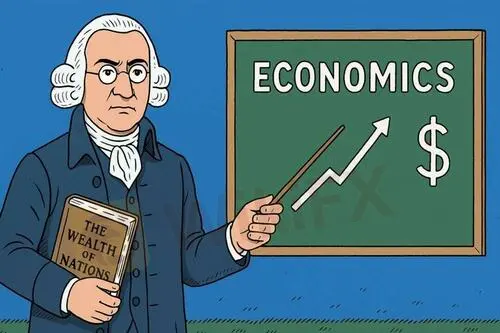
Let‘s go back to one of the most influential economics books ever written—a book on the scale of J.M. Keynes’s “The General Theory of Employment, Interest and Money” or Alfred Marshall‘s “Principles of Economics”—“Economics” by Paul Samuelson. It became one of the bestselling textbooks of all time, making a fortune for its author. But more important than its commercial success was its intellectual influence, prompting Samuelson to declare: “I don’t care who writes a nation‘s laws, if I can write its economics textbooks.” He was right. He is, in Keynes’s phrase, the “defunct economist” still shaping how we think. What truly mattered about his book was how it redefined the economists role.
Samuelson wrote: In Samuelson‘s world, the economist’s task is to assist the “men of good will” in government to solve social problems. Deirdre McCloskey captures this mindset best in her memoirs, recalling that when she studied for her Ph.D. at Harvard, her classmates all imagined they would go to Washington to “fine-tune” the economy.
Economic education since then has trained students to see themselves as assistants to these “men of good will,” solving technical equations for equilibrium and absorbing the idea that economics is an engineering problem rather than a coordination problem. Engineering problems deal with optimal solutions and data, but coordination problems deal with trade-offs and dispersed knowledge.
As Peter Boettke argues, in a world where all means and ends are known, the only task left is an engineering one. That is, essentially, what students learn in Econ 101—a world of perfect knowledge, known preferences, known prices, and calculable costs, where solving equations yields all the answers. But the real wisdom of economics lies in understanding deviations from this perfection.
This is where it gets tricky. Economists like Ha-Joon Chang criticise the field because perfection doesnt exist, and therefore they deem the models useless. But economists such as Frank Knight and Friedrich Hayek also start from the assumption of perfection—yet they do not stop there. They recognise the significance of market institutions precisely because we live in an imperfect world.
The market is one of humanitys greatest achievements for dealing with imperfection. In a world of perfect knowledge, markets would be meaningless. But in the real world, prices perform a miracle—they coordinate millions of decisions and “get Paris fed” without a central planner. Knight begins “Risk, Uncertainty and Profit” by imagining a world without risk, uncertainty, or profit, and then shows how markets function when those elements exist.
The problem is not perfection itself, but treating it as a policy goal for governments to achieve.In the Samuelsonian worldview, markets are full of imperfections—information asymmetries, externalities, monopolies and so on—but government is seen as perfect. The economist‘s role then becomes helping the state reach that imagined perfection. Perfection, in this mindset, ceases to be a theoretical tool and becomes a political mission. That is what is wrong with economics education. Perfection is a means of understanding the market’s value, not a utopia to be imposed.
This misunderstanding leads students to forget their limited knowledge about how to design human institutions. A sound economic education begins by viewing the market as a process, not a static state. It should show how our “propensity to truck, barter, and exchange” gives rise to miracles—from airplanes to iPhones—things unimaginable to those living just decades earlier. The beauty of economics lies not in trusting “men of good will” in government, but in trusting free individuals to make daily life better.
As the father of modern economics Adam Smith wrote, we should “allow every man to pursue his own interest his own way, upon the liberal plan of equality, liberty and justice.”

That hardly sounds like a “dismal” science to me.
Taught this way, economics is revealed as the story of human cooperation, with division of labour, profit, and loss guiding us toward more productive activity.But over the last half-century, Adam Smith‘s optimistic science of wealth creation has become the pessimistic science of choice under scarcity. In the latter, the problem is allocation, not coordination. And when economists see their task as calculating optimal allocations, they forget “the lesson of humility which should guard ... against becoming an accomplice in men’s fatal striving to control society,” as Hayek warned.
Disclaimer:
The views in this article only represent the author's personal views, and do not constitute investment advice on this platform. This platform does not guarantee the accuracy, completeness and timeliness of the information in the article, and will not be liable for any loss caused by the use of or reliance on the information in the article.
WikiFX Broker
Latest News
Australian Dollar drifts higher above 0.7200 despite as strong US NFP
WikiFXSwiss Franc weakens as US Dollar strengthens on Fed rate hike bets
WikiFXCouple Faced Over RM1.5 Million Loss After Stock Tip Scheme
WikiFXOANDA Is Shutting Down MT4 Trading by 25 September 2026
WikiFXBlackwell Global UK Loss Widens as Revenue Falls 37%
WikiFXLiquid Network Suffers from a US$320 Million Bitcoin Hack
WikiFXUnited States Dollar Index trades under pressure as Yen buying accelerates
WikiFXAustralian Dollar posts fresh three-month high amid hawkish RBA prospects
WikiFXBritish Pound climbs as USD fades, Hormuz risk keeps Fed in play
WikiFXXMR Markets Review 2026: Allegations of Failed Withdrawals & Bonuses
WikiFX