

Globale Broker-Regulierungsanfrage-App
WikiFX
Deutsch
简体中文
繁體中文
English
Pусский
日本語
ภาษาไทย
Tiếng Việt
Bahasa Indonesia
Español
हिन्दी
Filippiiniläinen
Français
Deutsch
Português
Türkçe
한국어
العربية
U.S. Labor Market Shows Continued Weakness in November
Zusammenfassung:The U.S. labor market softened further in November, reflecting a broad-based cooling as the economy transitions from the overheated conditions of the past two years into a more subdued phase. Nonfarm
The U.S. labor market softened further in November, reflecting a broad-based cooling as the economy transitions from the overheated conditions of the past two years into a more subdued phase. Nonfarm payrolls declined by 9,000—well below expectations—with Octobers figure revised down to a 15,500 decline. This deterioration signals that labor demand is no longer merely slowing; it is now entering a phase of structural contraction.
Sector performance was mixed. Education, healthcare, and construction continued to offer pockets of support, while leisure and hospitality became the primary drag. Job openings fell in tandem with declines in both hiring and quit rates, underscoring corporations diminishing appetite for expansion. Overall, the labor market is shifting into a distinctly “cool and contracting” environment.
Layoff data reinforces this narrative. U.S. companies announced 71,000 layoffs in November, up 24% year-over-year, marking the highest level for the month since 2022. Cumulative layoffs for the first eleven months of the year reached 1.171 million, a 54% surge from last year and the highest since the 2020 pandemic shock—also the sixth year since 1993 in which annual layoffs exceeded 1.1 million. Technology, telecommunications, and retail remain the hardest-hit sectors. Companies continue prioritizing efficiency amid elevated costs and high interest rates. AI-related restructuring alone accounted for 55,000 layoffs, highlighting how automation is reshaping workforce composition.
In contrast, hiring intentions collapsed. Planned hiring for the first eleven months totaled fewer than 500,000 positions, the lowest level since 2010 and down 35% from a year ago. This points to a broader corporate outlook characterized by caution and weak demand expectations.
Weekly employment data paints an even more contradictory picture:
• Initial jobless claims unexpectedly fell to 191,000, their lowest level since September 2022, defying expectations for an increase to 220,000.
• Yet continuing claims stayed near multi-year highs at 1.939 million, indicating that layoffs are not accelerating further—but those already unemployed are struggling to find new positions.
This dynamic reflects a “no hiring, limited firing” stagnation phase in the labor market.
Overall, the U.S. labor market is moving decisively toward a trajectory consistent with disinflation and slower economic growth. The cooling in worker mobility, muted hiring activity, and weakening demand expectations suggest the market has shifted from moderation into contraction. While these trends support the case for future Federal Reserve rate cuts, the pace of easing will depend on the speed of inflation decline in the coming months.
Gold Technical Analysis
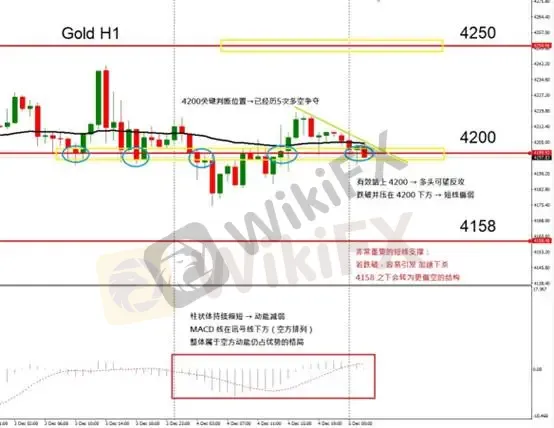
On the H1 chart, gold continues to oscillate around the $4,200 level, which has become the key battleground for near-term bulls and bears. Price action remains capped below this level, with the candlesticks facing downward pressure from the moving averages—indicating a bearish short-term bias.
Key Levels to Watch
Break above $4,200 → bullish momentum could resume
Failure to reclaim $4,200 → short-term weakness likely to persist
MACD Signals
Histogram continues to contract → momentum weakening
MACD line remains below the signal line → bearish alignment
Overall setup suggests bearish momentum remains dominant
Analyst View
Short-term bias remains bearish. Rebounds face selling pressure, with no bullish reversal yet from the MACD. Gold remains weak below $4,200, and traders should monitor $4,158 as a key support zone.
Resistance: $4,250/oz
Support: $4,200 / $4,158 per oz
Risk Disclaimer
The views, analysis, research, prices, and other information provided above constitute general market commentary only and do not represent the position of this platform. Readers should conduct their own due diligence and assume full responsibility for all trading decisions. Please exercise caution.
Haftungsausschluss:
Die Ansichten in diesem Artikel stellen nur die persönlichen Ansichten des Autors dar und stellen keine Anlageberatung der Plattform dar. Diese Plattform übernimmt keine Garantie für die Richtigkeit, Vollständigkeit und Aktualität der Artikelinformationen und haftet auch nicht für Verluste, die durch die Nutzung oder das Vertrauen der Artikelinformationen verursacht werden.
WikiFX-Broker
Wechselkursberechnung
USD

CNY
Aktueller Wechselkurs: 0
Bitte geben Sie den Betrag ein
USD
Konvertierbarer Betrag
CNY
Berechnen