

عالمی بروکر ریگولیشن چیک کرنے والا ایپ
WikiFX
اردو
简体中文
繁體中文
English
Pусский
日本語
ภาษาไทย
Tiếng Việt
Bahasa Indonesia
Español
हिन्दी
Filippiiniläinen
Français
Deutsch
Português
Türkçe
한국어
العربية
اردو


How Leverage and Margin Multiply Your Forex Wins and Losses

WikiFX
|


خلاصہ۔:Leverage and margin allow traders to control large positions with a small deposit. This article explains how they work, walks through a hypothetical example of profit and loss magnification, and clarifies common beginner misunderstandings.

Picture this: You open a forex account with $1,000. You hear that with leverage, you can control much more money. You take a trade, and within minutes, you see a gain that equals your entire deposit, or a loss that wipes it out. How is that possible? The answer lies in two connected concepts: leverage and margin.
 فہرست
فہرستWhat Leverage and Margin Are
Leverage is a tool that lets you control a large position with a relatively small amount of capital. It is expressed as a ratio, like 1:30 or 1:100. A ratio of 1:100 means that for every $1 you have, you can trade up to $100 worth of currency.
Margin is the actual amount of money your broker requires you to put up as a good-faith deposit to open a leveraged position. Think of it as a security deposit. When you open a trade, your broker “locks” a portion of your account balance as margin. The rest remains available as a buffer against losses.
- Leverage and margin are two sides of the same coin: higher leverage means lower required margin for the same trade size.
- Neither leverage nor margin changes the face value of your profit or loss in currency terms. What they change is how large a position you can control, and therefore how large your profit or loss can be relative to your account.
How Leverage Magnifies Profits and Losses: A Hypothetical Example
To see the effect clearly, walk through a simplified, hypothetical calculation. Suppose you have a $1,000 trading account. The EUR/USD exchange rate is 1.1535 (simulated for teaching).
Step 1: Choose a leverage ratio. Lets say your broker offers 1:100 leverage. This means you can control a position worth up to 100 times your capital, or $100,000.
Step 2: Calculate the margin. For a $100,000 position, the required margin is:
Margin = Position notional value ÷ Leverage. The notional value is the total face amount of the trade, in this case $100,000.
Margin = $100,000 ÷ 100 = $1,000.
So your entire $1,000 acts as the margin for this trade.
Step 3: See the effect of a 1% price move. If EUR/USD moves 1% in your favour, from 1.1535 to about 1.1650, the value of your position increases by 1% of the notional amount: $100,000 × 1% = $1,000.
- Your profit in dollars is $1,000.
- Your return on margin (and on your total capital) is 100%.
Now, if the price moves 1% against you, the loss is also $1,000, and your entire margin is gone.
Step 4: Compare with no leverage. Without leverage, your $1,000 could buy only about 867 EUR (1,000 ÷ 1.1535). If the exchange rate moves 1% in your favour, to about 1.1650, the value of those euros in dollars becomes approximately $1,010. So your gain would be roughly $10, exactly a 1% return on your starting capital. If the price moves 1% against you, you lose roughly $10.
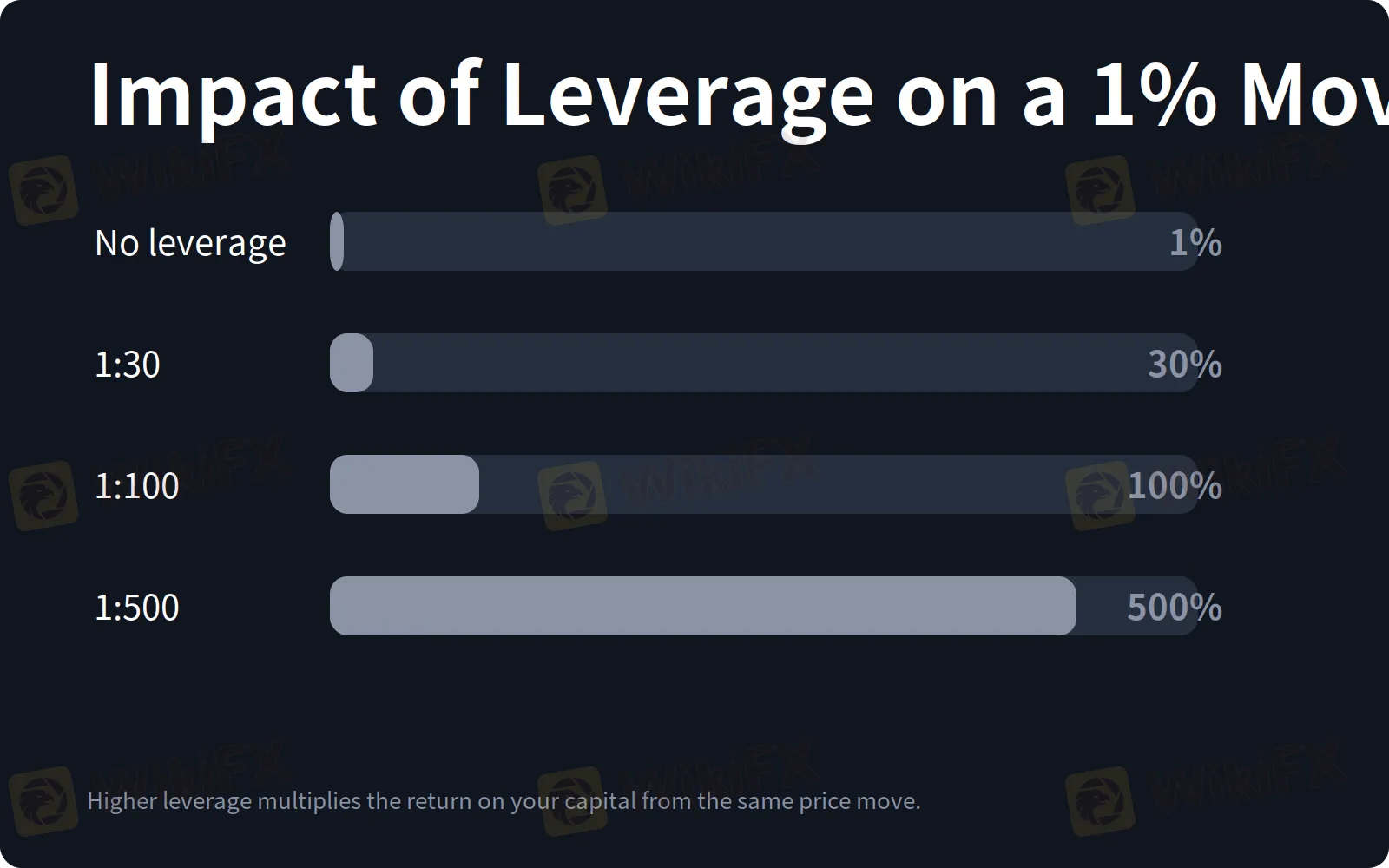
The table below illustrates how different leverage ratios amplify the return on your capital from that same 1% move, assuming you use the maximum leverage available:
- No leverage: 1% return on capital
- 1:30: 30% return
- 1:100: 100% return
- 1:500: 500% return
This is the magnification effect. It works in both directions, and it works on every trade.
Common Beginner Misperceptions
New traders often misunderstand key points about leverage and margin. Before exploring the misperceptions, lets quickly define a pip: a pip is the smallest standardised price move in a currency pair, usually 0.0001 for most pairs (so a move from 1.1535 to 1.1536 is one pip). Also, free equity is the portion of your account balance that is not currently tied up as margin.
Here are some of the most frequent misperceptions:
- “Leverage increases my risk only if I hold the trade overnight.” False. The size of your position is what determines the dollar value of every pip movement. Whether you hold for ten seconds or ten days, the risk per pip is the same.
- “A stop-loss order makes leverage safe.” A stop-loss can limit your loss to a planned amount, but it does not change how quickly a small adverse move can hurt you. If you use extreme leverage, even a few pips against you can trigger your stop and cause a large percentage loss.
- “Margin level is my safety net.” Margin level shows how much free equity you have left. Many beginners only pay attention when it is too late and the broker issues a margin call. A margin call means your broker is demanding more funds or closing your position because losses have eaten into your free equity and you no longer meet the margin requirement.
- “I can copy a professionals leverage ratio.” Leverage ratios do not work like a universal recipe. A professional may use 1:10, while a beginner with a small account might choose 1:500. The risk profile of the account, position size, and experience level are all different.
What Leverage Is (and What It Is Not)
One clear boundary can prevent a multitude of mistakes:
Leverage magnifies the financial impact of price moves on your account. It does not change the direction of the market, it does not predict anything, and it does not create profits where none exist.
Treat leverage as a tool of position sizing. The question is never “what leverage should I use?” but rather “how large a position can I responsibly control with my current account size and risk tolerance?” Understanding that difference is the first step toward using leverage as a scalpel rather than a sledgehammer.
ڈس کلیمر:
یہ مضمون صرف مصنف کی ذاتی رائے پر مبنی ہے، یہ پلیٹ فارم کی سرمایہ کاری کی مشورہ نہیں ہے۔ پلیٹ فارم مضمون کی معلومات کی درستگی، مکملیت اور بروقت ہونے کی کوئی ضمانت نہیں دیتا، اور مضمون کی معلومات پر اعتماد یا استعمال سے ہونے والے کسی بھی نقصان کی ذمہ داری قبول نہیں کرتا۔
